

Quick answer:
The Best alternatives to Ecwid are Wcart , Shopify, WooCommerce, BigCommerce, Wix, Squarespace and OpenCart. Each one fits a different kind of store: hosted platforms like Shopify, Wix, and Squarespace get you live fast with little technical setup; self-hosted options like WooCommerce, Magento, and OpenCart give you full control over the code but require more upkeep; and newer, headless platforms like BigCommerce and Wcart separate the storefront from the backend for stores planning multi-channel or multi-vendor growth.
Key Takeaways
- Store owners rarely leave Ecwid for one reason alone it’s usually a mix of hitting a customization wall, weak SEO controls, and wanting more say over checkout and storefront code.
- Ecwid holds roughly 2.2-6.3% of the ecommerce platform market depending on the tracking methodology, and is detected on about 0.3% of all analyzed websites. (Source: WMtips)
- Ecwid store counts fell 4.2% quarter-over-quarter and 27% year-over-year in Q2 2026, with active domains dropping from a peak of 137,083 in April 2025 to 128,541 by mid-2025. (Source: StoreLeads and TechnologyChecker.io)
- The digital commerce platform market is set to grow from $15.6B (2026) to $42.8B by 2033, a 15.5% CAGR. (Source: EIN Presswire)
Choosing an ecommerce platform isn’t a decision most store owners make more than once or twice in a business’s life, which is exactly why it’s worth slowing down on.
There’s no single “best” platform here the right pick depends on how technical your team is, whether you’re running one storefront or several, and how much of the day-to-day work you want a platform to handle versus how much you want to control yourself.
This guide breaks down eight options side by side, backed by real numbers where they exist, along with practical notes on migrating, keeping a store fast, and locking it down once you’ve made the switch.
Why Look for Ecwid Alternatives?
Ecwid is great for starting out but it has some limitations when your business grows.
The usual reasons stores move on:
- The design and layout options stop matching what the brand needs.
- SEO tools stay basic when competitors are running deeper technical SEO.
- Multi-channel and multi-vendor selling need workarounds instead of native support.
- Checkout and storefront customization hits a ceiling fast.
Ecwid isn’t a bad platform it’s just built for a different stage of business than the one you may be newly entering.
Quick Comparison: Best Ecwid Alternatives
| Platform | Best For | Setup Difficulty | Customization | Store Growth Support | SEO Control | Notable Limitation |
|---|---|---|---|---|---|---|
| WCART | Merchants scaling past a single storefront | Easy | High | High | Advanced | Smaller ecosystem than the legacy players |
| Shopify | Beginners who want to launch fast | Very Easy | Medium | High | Good | App costs add up quickly |
| WooCommerce | Store owners who want full code control | Medium | Very High | High | Excellent | You’re responsible for hosting and upkeep |
| BigCommerce | Brands past the early-growth stage | Medium | High | High | Excellent | Takes time to learn the back end |
| Wix | First-time store owners | Very Easy | Low | Low | Basic | Not built for a high order volume |
| Squarespace | Brands built around visual identity | Easy | Medium | Medium | Good | Ecommerce tools stay fairly surface-level |
| Magento | Enterprise teams with developers on staff | Hard | Very High | Very High | Advanced | Setup and maintenance need real dev resources |
| OpenCart | Sellers watching every dollar | Medium | High | Medium | Good | You’ll need someone comfortable with code |
What are the 8 Best Ecwid Alternatives?
1. Wcart – Best for Scaling Ecommerce Businesses
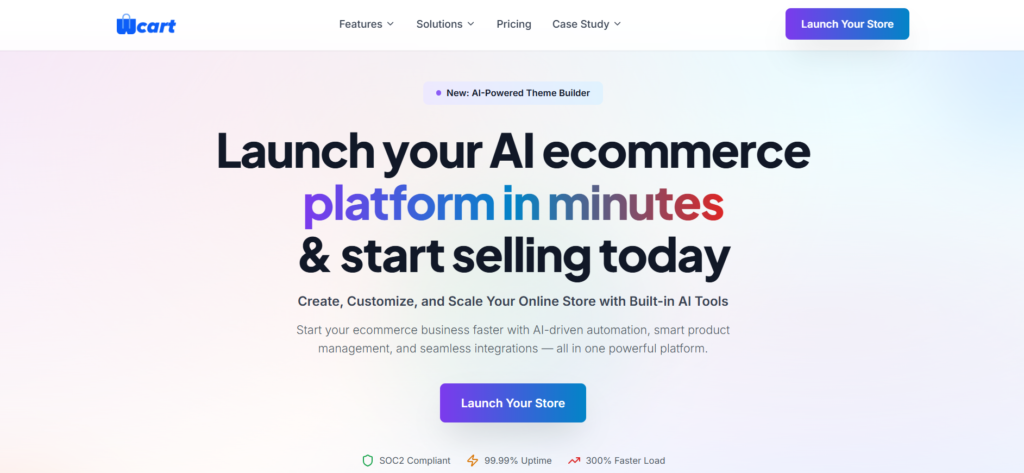
Wcart is a newer entrant built around a headless setup, meaning the part customers see (the storefront) and the part that runs the business (inventory, orders, catalog) are separated. In practice, that means you can redesign your storefront or plug it into a different front end without rebuilding your entire back office.
What it does well:
- Storefront and backend are separated, so a redesign doesn’t mean rebuilding your whole store from scratch.
- Multi-vendor support is built in, which matters if you’re running a marketplace model rather than a single-brand shop.
- SEO fields, including metadata, structured URLs, and sitemap control, are exposed to the merchant instead of locked behind a template.
- Catalog and order data move through an API, so connecting a mobile app or a custom checkout later doesn’t require starting over.
Where it stands today:
- WCART currently powers around 1,000 active stores, including Dekanta, a retailer shipping Japanese whisky to customers in more than 60 countries.
- Dekanta uses the headless setup to run international storefronts and localized checkout without maintaining separate codebases per region.
Real Platform Stats:
- 1,000+ active stores running on Wcart as of 2026, spanning single-brand storefronts and multi-vendor marketplaces.
(Wcart internal data, 2026) - 99.99% uptime, based on Wcart’s infrastructure monitoring over the trailing 12 months.
(per Wcart status page) - Up to 300% faster load speeds compared to a typical legacy platform setup, based on internal benchmark testing against comparable storefronts running similar catalog sizes.
Best for:
- A merchant planning a multi-vendor or multi-region setup who wants the storefront kept separate from the backend systems running the business.
Case Study: How Dekanta Scaled with Wcart

A strong example of ecommerce growth is Dekanta a global retailer of Japanese whisky.
With WCART’s headless ecommerce infrastructure, Dekanta successfully scaled its global operations and delivered faster digital experiences to customers in 60+ countries. WCART helped Dekanta improve performance, support growth, and build a scalable ecommerce ecosystem for long-term success.
Read More: To Know about Dekanta case study
2. Shopify – Best for Ease of Use

Shopify is the platform most people picture when they think “online store.” It handles hosting, security, and payments out of the box, and its app store has thousands of add-ons for nearly anything you’d want to bolt on.
What it does well:
- You can go from signup to a live store in an afternoon, with no developer required for a standard setup.
- Payment processing is built in, so you’re not stitching together a separate gateway or negotiating your own merchant account.
- Themes are built to look right on a phone screen by default, without extra work on your end.
- Nearly every marketing and inventory tool you’d want already exists as a pre-built app, so you’re rarely starting from zero.
Where it stands today:
- Shopify is the leading platform among fashion and apparel merchants specifically, with roughly 770,000 apparel stores built on it, which matters if you’re selling physical goods in a crowded retail category. (Source: Statista)
Cons:
- Monthly costs can increase with apps
- Limited customization compared to open source platforms
Best For:
- a small or mid-sized team that wants to launch without hiring a developer and is comfortable paying for convenience through apps.
Read More: To Know about Shopify Alternatives
3. WooCommerce – Best for Flexibility
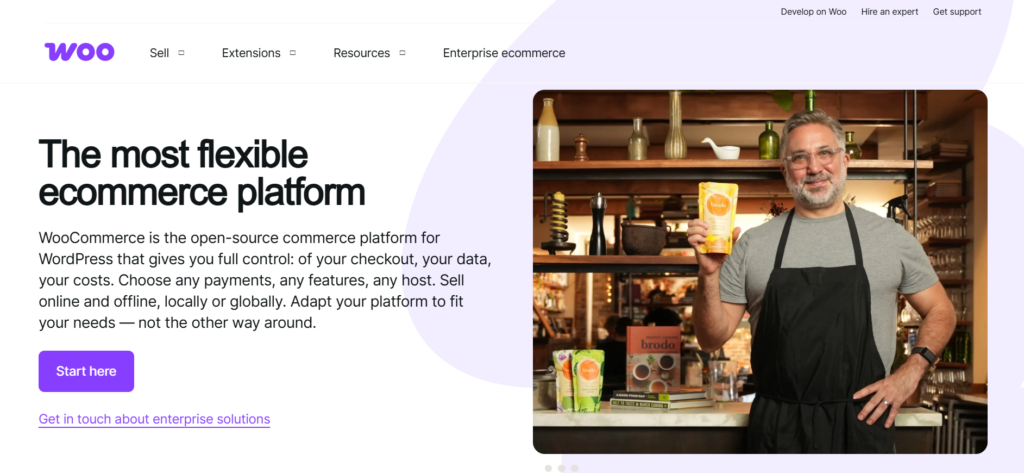
WooCommerce runs as a plugin on top of WordPress, which means your store lives inside a system millions of sites already use. Because it’s open source, you’re never locked into one company’s roadmap or pricing decisions.
What it does well:
- You own the code, so nothing about your store’s function is off-limits to you or a developer you hire.
- The plugin library covers nearly every feature a Shopify app store would, often for free or at a one-time cost instead of a recurring fee.
- Because it’s WordPress underneath, your product pages and blog content share the same SEO foundation, which makes content marketing and product SEO easier to run side by side.
- There’s no monthly platform fee you pay for hosting and whichever plugins you choose, which can work out cheaper at scale than a percentage-based platform.
Where it stands today:
- WooCommerce is the most widely used ecommerce software worldwide by store count, and it holds around 40% share across European ecommerce markets specifically, ahead of every other platform on this list. (Source: Statista; Tembi Market Intelligence)
Cons:
- Requires technical knowledge
- Hosting and maintenance needed
Best For:
- Businesses that want flexibility and control over every aspect.
Read More: To Know about WooCommerce Alternatives
4. BigCommerce – Best for Scaling Without Apps
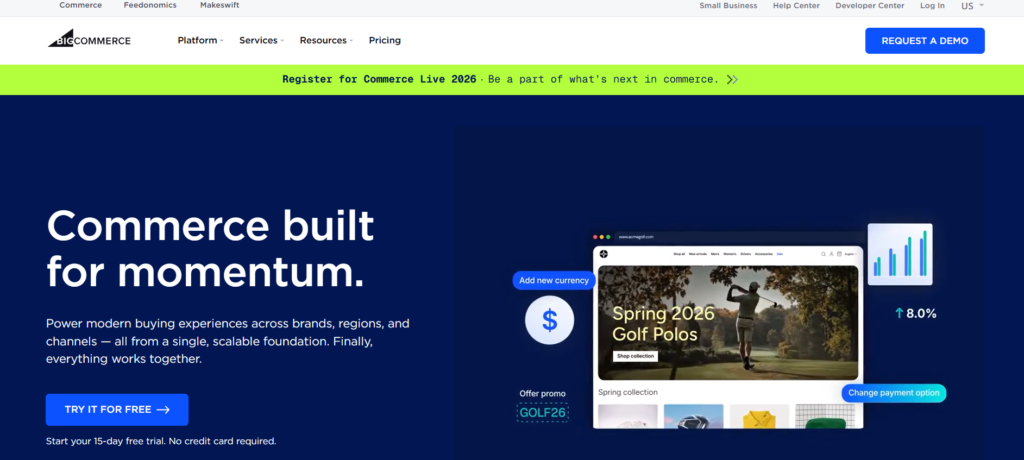
BigCommerce sits a notch above Shopify in terms of what’s included by default. Multi-channel selling, advanced product options, and stronger SEO tools come standard rather than requiring extra apps.
What it does well:
- Selling across your own site, Amazon, eBay, and social channels is built into the core plan instead of needing a separate app for each channel.
- There’s no added transaction fee on top of your payment processor’s cut, which adds up over a year of sales.
- Product variants and catalog rules go deeper than what Shopify offers by default, which matters for stores with a lot of size, color, or bundle combinations.
- SEO controls extend down to individual product fields, not just page templates, giving more room to fine-tune how products show up in search.
Cons:
- Expensive for small businesses
- Learning curve
Best For:
- Mid to large businesses planning long term growth.
Read More: To Know about BigCommerce Alternatives
5. Wix – Best for Beginners
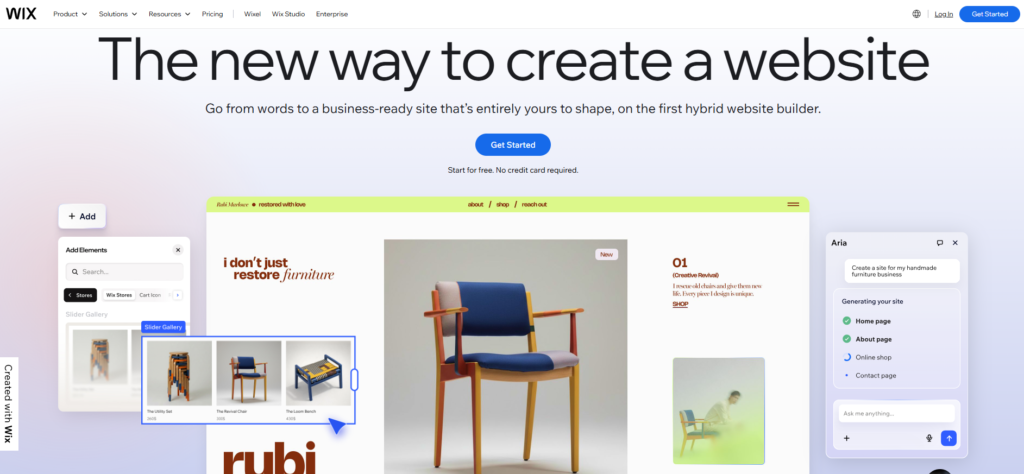
Wix is a drag-and-drop website builder that added ecommerce as one of its features. If your catalog is small and your priority is getting something live without a learning curve, it does the job.
What it does well:
- Building a page is closer to arranging blocks than writing code, which suits someone with no design or development background.
- Templates already look finished without much editing, so a store can look put-together on day one.
- Marketing tools like email campaigns and coupon codes come built in rather than needing a separate subscription.
- Site and store live in the same editor, so there’s no juggling a separate ecommerce plugin on top of a website builder.
Cons:
- Limited scalability
- Not ideal for complex stores
Best For:
- Beginners and small businesses.
Read More: To Know about Wix Alternatives
6. Squarespace – Best for Design-Focused Stores

Squarespace is known first for design. Photographers, boutique brands, and portfolio-driven businesses often pick it because the templates look professional with minimal tweaking.
What it does well:
- Templates are genuinely well designed out of the box, not just functional, which saves real design time for a small brand.
- Blogging and store content live in the same system, so content marketing doesn’t need a separate tool or login.
- Day-to-day management stays simple even for someone without a technical background, from adding products to running a sale.
- Built-in analytics give a reasonable picture of traffic and sales without needing to bolt on a separate tool.
Cons:
- Limited advanced ecommerce features
- Less flexible than WooCommerce
Best For:
- Creative businesses and personal brands.
Read More: To Know about Squarespace Alternatives
7. Magento – Best for Enterprise Customization
Magento is built for businesses running complex catalogs, multiple storefronts, or high transaction volume, and it assumes you have technical staff to run it.
What it does well:
- Multiple stores and storefronts can be managed from one back end, which matters for a company running several brands or regions.
- Nearly every part of the checkout and catalog logic can be rewritten to match specific business rules, down to how pricing or shipping is calculated.
- It handles a high volume of products and orders without buckling, which is where smaller platforms tend to struggle.
- Being owned by Adobe means it connects well with other Adobe marketing and analytics tools if a company already uses them.
Cons:
- Expensive
- Requires developers
Best For:
- big companies with technical teams.
Read More: To Know about Magento Alternatives
8. OpenCart – Best Budget-Friendly Alternative
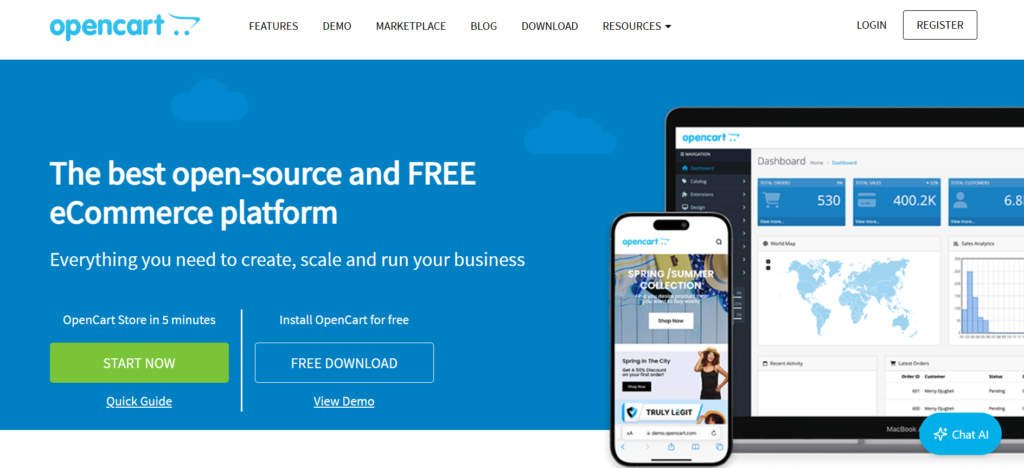
OpenCart is free, open source, and has been around long enough to have a stable extension marketplace, even if it’s smaller than WooCommerce’s.
What it does well:
- There’s no license fee you only pay for hosting and any paid extensions you choose, which keeps the starting cost low.
- Multiple storefronts can run from a single install, useful for a seller managing more than one brand.
- It stays lightweight, which keeps page load times reasonable even on modest, inexpensive hosting.
- The admin interface, while dated in appearance, is straightforward once you’ve spent a little time in it.
Cons:
- Requires technical setup
- Smaller community compared to WooCommerce
Best For:
- A budget-conscious seller who doesn’t mind a bit of technical lifting in exchange for a lower starting cost.
Read More: To Know about OpenCart Alternatives
Migration : What Actually Happens When You Switch Platforms
Leaving Ecwid isn’t just flipping a switch. Here’s what the move typically involves:
- Export your data: Product catalog, customer records, and order history need to come out of Ecwid in a clean, structured format usually CSV for products and customers.
- Clean the data before you import it: Mismatched categories, duplicate SKUs, and missing images cause more headaches after migration than during it. Fix them first.
- Set up redirects: Every product and category URL that changes needs a 301 redirect pointing to its new address, or you’ll lose the search rankings those pages already earned.
- Reconnect payment and shipping: Your new platform needs its own payment gateway and shipping rule setup these don’t carry over automatically.
- Test orders before going live: Run a handful of test purchases through the new checkout, including any discount codes or tax rules, before pointing real customers at it.
- Keep the old store live briefly: A short overlap period where both stores exist gives you a fallback if something in the new setup needs fixing.
Optimizing Your Website on a Website Builder
Picking a platform is step one. Getting real performance out of it takes ongoing attention:
- Compress product images before uploading them: Large, uncompressed photos are still one of the most common reasons store pages load slowly.
- Keep your category structure shallow: Two or three clicks from the homepage to any product is a reasonable target more than that and both shoppers and search engines start to lose the thread.
- Write unique product descriptions: Copying a manufacturer’s description onto ten different stores does nothing for your search rankings and reads as generic to shoppers too.
- Check your mobile experience separately from desktop: Most ecommerce traffic now comes from phones, and a store that looks fine on a laptop can still have a checkout button that’s hard to tap on mobile.
- Watch your page speed after every major theme or app change: New apps and plugins are a common, overlooked cause of a store slowing down over time.
Security: What to Ask Before You Commit to a Platform
Security isn’t the most exciting part of picking a platform, but it’s the part that causes real damage when it’s ignored.
- Who handles PCI compliance?
- Hosted platforms like Shopify and BigCommerce manage this for you. Self-hosted platforms like WooCommerce and Magento put more of that responsibility on you or your hosting provider.
- Is there a real SSL certificate on every page, not just checkout?
- Search engines and browsers both flag mixed content, which can quietly hurt trust and rankings.
- How are software updates handled?
- Hosted platforms push updates automatically. Self-hosted ones require someone to apply security patches on a schedule skipping this is one of the more common ways small stores get compromised.
- What’s the backup policy?
- Ask specifically how often backups run and how quickly you could restore from one if something went wrong.
- Does the platform support two-factor authentication for admin accounts?
- This alone blocks a large share of account takeover attempts, and it should be table stakes at this point.
How to Choose the Right Ecwid Alternative?
A few honest questions to ask yourself before deciding:
- Do you want a developer’s level of control, or would you rather the platform handle the technical side for you?
- Is your business a single storefront, or are you planning a multi-vendor or multi-channel setup?
- How much of your budget is realistic to spend monthly, once apps and add-ons are factored in?
- Does your team have the technical background to manage a self-hosted platform, or do you need something hosted end to end?
1. Consider WCART if you’re planning a multi-vendor setup, want your storefront separated from your back-end systems, and expect to need more SEO control than Ecwid gives you.
2. Consider Shopify or Wix if speed to launch matters more than deep customization right now.
3. Consider WooCommerce, Magento, or OpenCart if you want full ownership of your store’s code and have the technical resources to support that.
Final Thoughts
Ecwid is an excellent place to start but it might not be sufficient for long term expansion.
As ecommerce grows more competitive companies require:
- Faster websites
- Better user experience
- Scalable infrastructure
Platforms like Wcart are special because they combine performance flexibility and real world scalability, backed by data and case studies.
Frequently Asked Questions
Compare every option: Best Ecommerce Platforms in 2026: An Honest Look — the full ecommerce platform comparison, and where Wcart wins. Start a free Wcart trial.

























Leave a Reply