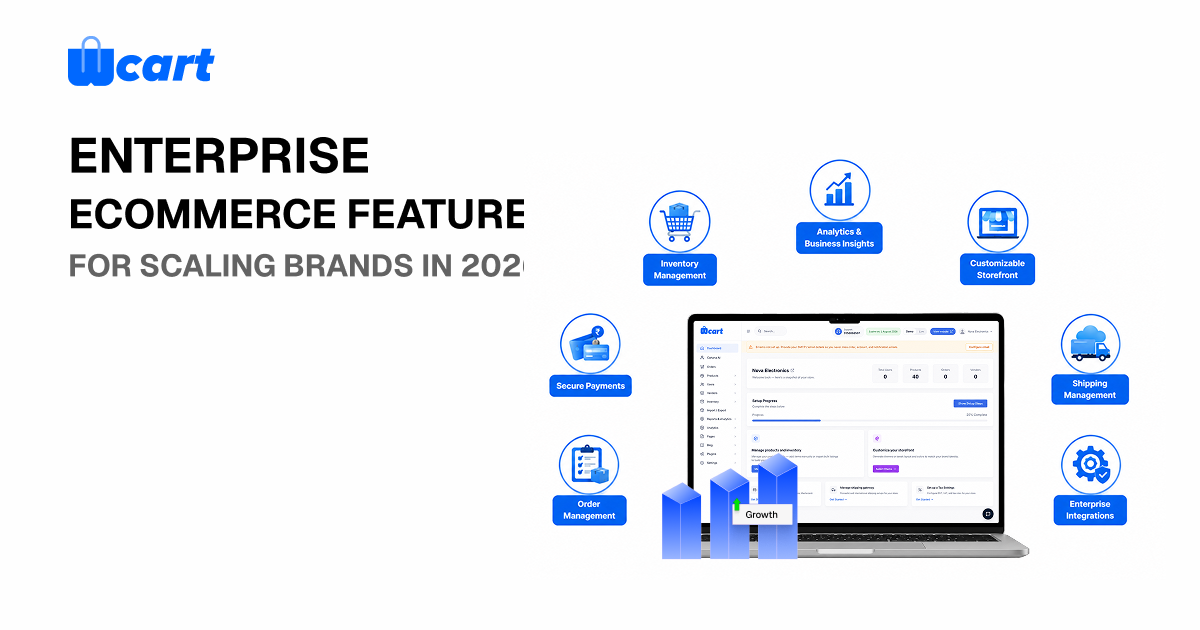
Enterprise ecommerce features give businesses the tools to manage large catalogs, complex orders, multiple currencies, different sales channels, and third-party integrations from one platform. Key features include headless commerce, advanced inventory control, marketplace support, mobile commerce, strong security, analytics, and tools for selling across countries.
Key Takeaways
Enterprise buyers are comfortable making large purchases online35% of B2B buyers say they are willing to spend $500,000 or more in a single digital transaction, while 15% are comfortable spending more than $1 million online. (Source: McKinsey )
Smartphones accounted for nearly 80% of retail ecommerce website visits worldwide in 2025, while mobile commerce revenue was estimated at around $2.5 trillion. (Source: Statista)
Marketplaces are becoming part of the B2B buying mix — 60% of B2B buyers say they are open to purchasing through digital marketplaces. (Source:McKinsey )
Shopify reports maintaining 99.9% platform uptime and supporting more than 40,000 checkouts per minute during major sales events. This illustrates the level of infrastructure enterprise merchants expect when traffic and transaction volume spike. (Source: Shopify )
When a store outgrows its first platform, the problem is almost never “we need more products.” It’s the enterprise ecommerce features that let a brand sell across channels, regions, and business models without tearing everything down and starting over.
This guide walks through the capabilities that actually separate enterprise-grade commerce from a basic storefront in 2026, and points you to deeper resources for each one so you can plan your stack with eyes open.
Ready to Run Your Store Through WhatsApp?
Create your Wcart store and manage products, prices, stock, and orders simply by chatting on WhatsApp – no dashboard needed.
What “enterprise ecommerce” actually means in 2026
Enterprise ecommerce is less a price tier than a set of architectural bets. A basic store is built to take orders. An enterprise ecommerce platform is built to absorb growth: heavier traffic, more SKUs, multiple storefronts, several currencies, messy fulfillment, and integrations with the rest of the business. You feel the difference the first time you try to do something the platform was never designed for.
It also shows up in how a platform handles change. Basic stores assume your business stays roughly the same shape forever. Enterprise platforms assume it won’t. Adding a sales channel, a new market, or a whole new revenue model becomes a configuration decision instead of a rebuild.
Here’s my honest take after watching dozens of brands hit this wall: that flexibility is the single biggest reason scaling brands buy enterprise tooling slightly before they technically need it. Waiting until you’re on fire is the expensive way to learn the lesson.
The features below are the ones that consistently decide whether a brand can keep scaling on its current platform or gets forced into a migration mid-growth. Treat this as a hub. Each section is a short overview with a link to a dedicated deep dive for when you’re ready to evaluate that capability properly.
1. Headless architecture and a real commerce API
Headless commerce splits the storefront (the “head”) from the backend that runs products, carts, and orders. Instead of being stuck with one templated frontend, your team builds whatever experience it wants on top of a commerce API, then reuses that same backend for web, mobile, kiosks, and channels that don’t exist yet.
The practical payoff is speed and freedom. Marketing can ship a new landing experience without waiting on a monolithic release. Engineering picks modern frontend frameworks and a global CDN for fast page loads everywhere. And because the data layer is exposed through clean APIs, you can wire commerce into your ERP, PIM, CRM, and analytics instead of running yet another silo.
If headless is on your roadmap, know this: the architecture choices you make early define your ceiling later. Our guide to enterprise ecommerce development covers how to plan an API-first build, what to keep in-house versus integrate, and how to dodge the re-platforming traps that catch most teams.
2. Multi-vendor marketplace capability
Some brands grow by selling more of their own catalog. Others grow by becoming a platform where other sellers list, sell, and fulfill. A marketplace model rewrites the economics: you earn commission on third-party sales without holding the inventory, and your catalog expands far faster than you could ever stock it yourself.
That only works if the platform supports it natively. You need vendor onboarding, per-vendor storefronts and dashboards, split payouts, commission rules, and order routing so each seller fulfills their own items. Bolting this onto a single-seller platform is exactly where most marketplace projects stall out.
Weighing whether to open your store to outside sellers? Start with our complete multi-vendor marketplace guide. It walks through commission structures, vendor management, and the operational model behind a marketplace that doesn’t collapse under its own weight.
3. White-label and multi-store control
Agencies, franchises, and brands with multiple labels need to run many storefronts from one operational core, usually under their own branding rather than the platform’s. White-label capability lets you present the whole experience as your product, spin up new branded stores quickly, and manage them from one place.
Two groups feel this most. Agencies can resell commerce as a packaged offering. Multi-brand companies can launch a new label or regional store without standing up separate infrastructure every single time. The win is consistency plus control: shared back-office, separate front-of-house.
For a deeper look at reseller economics, branding control, and the point where this model actually pays off, see our breakdown of white-label ecommerce.
4. Native mobile apps
Mobile is where your loyal customers shop. A dedicated app does things the mobile web simply can’t: push notifications, faster repeat checkout, offline browsing, and a home-screen icon that quietly drives retention. For brands with a returning customer base, an app often turns into the highest-converting channel they own.
The traditional catch was cost and maintenance. Building iOS and Android separately, then keeping both in sync with the website, eats budget fast. Enterprise platforms solve this by generating apps from the same commerce backend, so catalog, pricing, and orders stay unified across web and mobile.
If a branded app is on your shortlist, our guide to ecommerce mobile apps covers when an app is worth building, which features actually drive retention, and how to keep web and app in lockstep.
5. Video commerce
A static product photo answers fewer questions than a 30-second clip. Video commerce pulls shoppable video, livestream selling, and product demos straight into the buying flow, which lifts engagement and cuts the uncertainty that fuels returns. In fashion, beauty, electronics, and home, it’s fast becoming a default expectation rather than a nice-to-have.
The enterprise version isn’t embedding a YouTube link and calling it done. It’s video tied to your catalog, with in-video add-to-cart, live shopping events, and analytics on what converts. Done well, content becomes a measurable sales channel instead of a vanity metric.
To see how shoppable and live video fit into a modern storefront, read our overview of video commerce.
6. Advanced order management
Order management is where scaling brands quietly break. At low volume, almost any system works fine. At high volume you need centralized order capture across channels, inventory sync, partial fulfillment, returns handling, and batch processing, or support and operations end up drowning in manual work.
A capable order management system (OMS) becomes the operational backbone: one source of truth for every order no matter where it came from, with rules that route, split, and update fulfillment automatically. The right OMS is frequently the line between scaling smoothly and hiring people just to paper over a fragile process.
No enterprise store is an island. It has to trade data with accounting, fulfillment, marketing, and often partner systems. Solid API access and batch order support are what make that possible, letting you sync products, push orders, and pull analytics programmatically instead of through CSV exports and manual reconciliation at midnight.
This goes double for B2B sellers, who live with customer-specific pricing, quote workflows, purchase orders, credit terms, and large repeat orders. A platform built only for B2C consumer checkout will fight you at every turn. The fix is an API-first backend plus B2B-aware workflows that expect this complexity instead of choking on it.
If you sell to businesses, our guide to common B2B ecommerce challenges covers pricing tiers, account hierarchies, and the integrations B2B buyers take for granted.
8. Security, compliance, and reliability
At enterprise scale, trust is a feature. Customers, partners, and procurement teams want proof that their data is handled responsibly and that the store will be up when they need it. That means SOC 2-aligned controls, secure payment handling, and a platform engineered for high availability rather than best-effort uptime.
Reliability shows up in the numbers: a high uptime target, a global CDN that keeps the store fast under load, and infrastructure that absorbs traffic spikes during launches and sale events. Compliance shows up in due diligence. When an enterprise customer or partner asks how you protect data, you need a clear answer ready, not a scramble. This also feeds directly into how search engines and buyers judge you; Google’s own guidance on creating helpful, trustworthy content leans heavily on signals of expertise and trust, and a store that’s secure and dependable reinforces exactly that.
None of these are features a customer spots on a product page. They’re the ones that close enterprise deals and protect the brand when something goes sideways.
9. Scalability and global selling
Last, the feature that ties the rest together: the platform’s ability to grow with you. Scalability isn’t only about handling more traffic. It’s about supporting multi-currency and multi-language selling so you can enter new markets, expand your catalog without a performance penalty, and add business models (marketplace, B2B, subscriptions, print-on-demand) without a migration.
Global selling in particular is what separates ambitious brands from local ones, and cross-border demand keeps climbing year after year, as industry trackers like Statista’s ecommerce research consistently show. Native multi-currency pricing, localized languages, and regional fulfillment let you serve customers wherever they are. And for brands testing new product lines with low risk, print-on-demand dropshipping lets you launch merchandise without holding any inventory at all.
Enterprise vs. basic ecommerce, at a glance
Architecture: A basic store gives you a fixed, templated frontend. Enterprise goes headless and API-first, so you control the experience.
Business models: Basic stores sell one catalog and stop there. Enterprise platforms layer on marketplaces, white-label, B2B, and print-on-demand.
Channels: Web-only is the basic story. Enterprise reaches web, native mobile apps, and shoppable video from one backend.
Operations: Manual order juggling defines basic stores. Enterprise runs centralized order management with batch processing and integrations.
Trust: Best-effort uptime is the basic norm. Enterprise commits to high availability, a global CDN, and SOC 2-aligned security.
Reach: Basic stores sell locally. Enterprise sells in multiple currencies and languages, worldwide.
Real Stories
This isn’t theory, either. Real brands run their stores on enterprise platforms like Wcart today, including the whisky cask marketplace Cask Empire and the Japanese whisky retailer Dekanta, both of which sell across markets and currencies from a single backend.
Frequently Asked Questions
What features make an ecommerce platform “enterprise-grade”?
Enterprise-grade platforms pair headless architecture and a full commerce API with multi-vendor, white-label, mobile app, and video commerce capabilities, then add advanced order management, deep integrations, and security and compliance such as SOC 2-aligned controls and high availability. The common thread: they absorb growth across channels, regions, and business models without forcing a re-platform.
Do I need headless commerce to be considered enterprise?
Not strictly, but headless architecture is increasingly the foundation enterprise brands choose. By splitting the storefront from the backend and exposing everything through an API, headless gives you room to build custom experiences, reuse one backend across web and mobile, and integrate with your ERP, PIM, and CRM. For a scaling brand, it’s the most future-proof starting point.
When should a brand move from a basic store to an enterprise platform?
The triggers are usually operational. You’re managing orders manually across channels, hitting limits on currencies or languages, itching to add a marketplace or B2B model, or fighting your platform to launch a mobile app or custom frontend. Once you’re building workarounds for features the platform was never meant to support, evaluate enterprise options before growth forces a rushed migration on you.
Can one platform handle B2C, B2B, and marketplace selling together?
Yes, when it’s designed for it. A platform with an API-first backend, multi-vendor support, and B2B-aware workflows can run consumer checkout, business pricing and quotes, and third-party seller fulfillment from the same core. The trick is choosing a platform that supports these models natively rather than bolting them on, so your operations and data stay unified.
Can an enterprise ecommerce platform support B2B and B2C sales?
Yes. The right platform can support both models from the same commerce system, including customer-specific pricing, business accounts, bulk orders, quotes, consumer checkout, promotions, and different purchasing workflows.
How important are ecommerce integrations for enterprise businesses?
They are critical because enterprise stores often rely on systems such as ERP, CRM, PIM, payment gateways, shipping providers, marketing tools, and inventory software. Strong API connectivity helps these systems exchange data without creating disconnected workflows.
Does an enterprise ecommerce platform need headless architecture?
Not necessarily. However, headless architecture can be useful when a business needs a custom storefront, mobile apps, multiple customer touchpoints, or connections with several backend systems. It separates the customer-facing experience from the commerce system behind it.
Scale your brand on Wcart
Every capability in this guide, from headless architecture and a real commerce API to multi-vendor marketplaces, white-label stores, native mobile apps, video commerce, and print-on-demand, is built into Wcart, the AI-based headless ecommerce platform by Webnexs. Launch code-free with a drag-and-drop builder and AI theme builder, sell in multiple currencies and languages on a global CDN with 99.99% uptime and SOC 2 compliance, and add enterprise capabilities as you grow. Explore Wcart and start scaling your store today.



























Leave a Reply