
Quick Answer : White-label ecommerce is one of the quickest ways to put a fully branded online store platform in front of customers without building the technology yourself. You don’t write the engine from scratch. You license a proven one, wrap it in your own brand, and sell it as your own product. Pricing typically runs from a few hundred dollars a month for agency tiers up to custom enterprise contracts, and most agencies go live in 2–4 weeks rather than the 6–12 months a custom build takes.
Key Takeaways: White-Label Ecommerce by the Numbers
- The global ecommerce platform market is valued at roughly $11.55 billion (2025), projected to grow to $61.83 billion by 2034 at a 20.49% CAGR. (Source : Fortune Business Insights)
- Global SaaS spending the broader category white-label ecommerce platforms fall under is expected to cross $209 billion in 2026, with white-label solutions cited as a major growth driver. (Source : OnGraph)
- The wider white-label market (software and services combined) was estimated to reach roughly $700 billion between 2021 and 2026. (Source : Kaily)
- White-label SaaS reseller margins commonly run $100–$700 per customer per month, depending on niche and product depth. (Source : CamelDigital)
- Broader white-label software resale margins across categories run 40–80%, according to agency-reported data. (Source : Full Stack Freedom)
This guide walks through what white-label ecommerce really is, who it’s a fit for, the upside and the traps, how it stacks up against the alternatives, and a practical launch plan for 2026.
Real Results
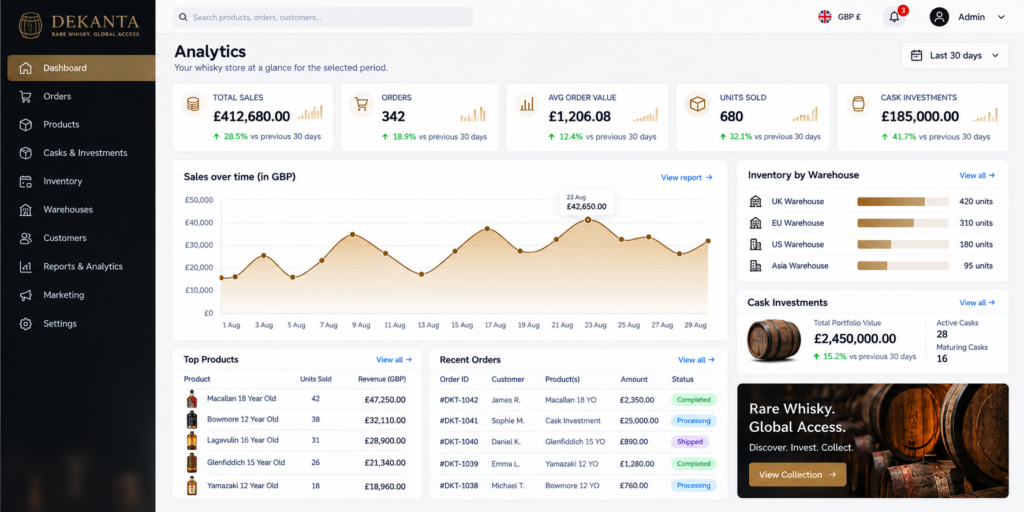
Dekanta, a UK/Japan-based premium and rare whisky retailer, needed a platform that could handle multi-warehouse logistics, and cask-investment tracking at scale. Wcart built a custom solution with real-time inventory sync and zero-downtime migration driving 10x revenue growth and $500K+ in monthly revenue.View Full Case Study→
Ready to Run Your Store Through WhatsApp?
Create your Wcart store and manage products, prices, stock, and orders simply by chatting on WhatsApp – no dashboard needed.
What Is White-Label Ecommerce?

White-label ecommerce is a model where a vendor builds and maintains a complete ecommerce platform, and you put your own brand on top of it.
Your end customer sees your logo, your domain, your colors, and a branded admin panel and apps.
They never see the original vendor. You get a market-ready product. The vendor quietly carries the engineering, hosting, security, and ongoing maintenance.
The practical upshot is that you own the brand-facing layer while inheriting serious infrastructure underneath: a headless API, a content delivery network, multi-currency and multi-language support, and the kind of uptime you’d struggle to guarantee on your own.
Who Is White-Label Ecommerce For?

This model suits any business that wants to sell or operate an ecommerce platform without turning into a software company. A few groups tend to adopt it first.
A few groups tend to adopt it first:
- Agencies and web studios – a repeatable branded platform beats rebuilding the stack on every client project.
- SaaS companies – bolting commerce onto an existing product and billing it as a native feature.
- Resellers and consultants – chasing recurring revenue from a productized offering with their own name on it.
- Larger retailers and enterprises – running sub-brands, regional storefronts, or franchise networks that need to stay on-brand and under central control.
The common thread is simple: if your customers expect to deal with your brand from start to finish, white-label lets you deliver that without a multi-year build.
The Benefits of Going White-Label
Speed to market
- Time is the biggest win, and it isn’t close. The platform is already built, tested, and running in production.
- You can launch in weeks instead of the many months a ground-up build eats up, and you can be onboarding customers while a competitor is still writing requirements docs.
Full brand control
- Done right, white-label leaves no trace of the vendor. You own the logo, the custom domain, the branded admin experience, even branded mobile apps.
- As far as your clients can tell, the platform is yours and always was.
Recurring revenue
- You own the customer relationship, so you set the pricing and the billing.
- Plenty of agencies and resellers turn a white-label platform into a subscription product, stack their own services on top, and end up with predictable monthly revenue that compounds.
- Here’s my honest take: this is where the model earns its keep. Speed gets you live, but the recurring billing is what turns a project shop into a real business.
Lower risk and maintenance burden
- Security patches, scaling, uptime, compliance: all of that stays with the vendor. You spend your time selling, supporting, and growing instead of running data centers or chasing the next vulnerability.
Top 5 White-Label Ecommerce Platforms in 2026
Here’s how the main contenders stack up if you’re shortlisting right now.
| Platform | Best For | Starting Price (white-label tier) | Notable Strength |
|---|---|---|---|
| Wcart | Agencies & resellers wanting full brand removal fast | Enterprise tier, custom pricing | Headless API, fully branded mobile apps |
| Shopify Plus | High-volume retailers and franchises | ~$2,300/month | Massive app ecosystem, proven at scale |
| BigCommerce Enterprise | Mid-to-large B2B and multi-storefront brands | Custom pricing (enterprise-only) | Strong native B2B and multi-storefront tools |
| Wix Studio | Agencies serving smaller SMB clients | ~$159/month per client site (agency plans) | Fast setup, low technical overhead |
| Adobe Commerce (Magento) | Enterprises needing deep customization | Custom licensing, typically $22,000+/year | Extremely flexible, large developer ecosystem |
- Wcart – An AI-based headless ecommerce platform that gives agencies and resellers full white-label capability on its Enterprise tier: your own brand, domain, and apps, with all Wcart branding removed, backed by a headless API, CDN and SOC 2 security. Real brands like Dekanta and Zeekas already run on it.
- Shopify Plus – The default choice for high-volume retailers wanting a proven, battle-tested platform with the largest app ecosystem in ecommerce, though white-labeling requires its Plus-tier partner program.
- BigCommerce Enterprise – A strong pick for B2B sellers and brands running multiple storefronts under one account, with native multi-storefront tooling that’s harder to replicate elsewhere.
- Wix Studio – The fastest, lowest-overhead option for agencies serving smaller SMB clients who don’t need deep customization, at the cost of some flexibility at scale.
- Adobe Commerce (Magento) – The most customizable option, favored by enterprises with complex requirements and in-house developer teams, but it comes with the highest cost and longest setup time on this list.
How Much Does White-Label Ecommerce Cost in 2026?
Pricing varies a lot by vendor and scale, but here’s roughly what to expect when budgeting:
- Agency/starter white-label tiers: roughly $200–$800/month, usually capped on number of client stores or products.
- Growth tiers: roughly $800–$3,000/month, with higher store caps, more branding controls, and API access.
- Enterprise tiers: custom pricing, often $3,000+/month or negotiated annual contracts, usually required for full white-label (zero vendor branding anywhere, including invoices and login screens).
- Setup/onboarding fees: some vendors charge a one-time setup fee ($500–$5,000) for white-label configuration; others waive it on annual contracts.
- Revenue-share alternative: a handful of vendors skip flat fees entirely and instead take a percentage of what you bill your end clients worth comparing against a flat-fee tier if you’re pre-revenue.
A note on white-label features: White-label isn’t a fixed add-on at Wcart, it’s built around what you actually need. If you need specific white-label features (custom domain, branded apps, removed branding, etc.), we build them for you. If you don’t need them, don’t pay for them.
What to Look For in a White-Label Platform
Plenty of platforms call themselves white-label without actually delivering a clean, brandable experience. Before you sign anything, pressure-test candidates against a few things.
- Start with rebranding, and be strict about it: storefront, admin panel, and apps should carry zero residual vendor branding.
- Look for a headless, API-first architecture so you’re free to customize the front end and wire in other systems. C
- heck reliability and scale, backed by a real uptime record, a CDN, and room to grow with your clients.
- Confirm the security and compliance story (SOC 2 and data handling you’d happily defend to a nervous client).
- If you serve multiple regions, multi-currency and multi-language support is non-negotiable. And dig into feature depth, including the kind of enterprise ecommerce features your most demanding clients will eventually ask for.
- Finally, read the licensing closely: it should explicitly permit white-labeling and reselling under your brand.
One more thing. If you ever plan to serve sellers who host other sellers, make sure the platform can also power a multi-vendor marketplace, so you’re not boxed in a year from now.
White-Label vs. Build-From-Scratch vs. Open Source
There are three broad ways to run your own branded platform, and each makes you pay somewhere.
Build from scratch
- You get maximum control and full ownership of the codebase. You also get the slowest, most expensive path, with engineering, security, and infrastructure costs that never really go away.
- This is essentially custom enterprise ecommerce development, and it only makes sense when your requirements are genuinely one of a kind.
Open source
- No license fee for the core software, and you can modify it however you like. The catch is staffing: you still need engineers to host, secure, update, and extend it.
- Once you add up DevOps, patching, and customization, the total cost of ownership usually runs higher than the sticker price suggests.
White-label
- This is the middle path. You get a production-grade platform, your own brand, and predictable costs, while the vendor shoulders the engineering.
- You trade some low-level control for a much faster launch and far less operational risk. For most agencies, resellers, and SaaS teams, it’s the most efficient route by a wide margin.
B2B Ecommerce White Label Solution
White Label B2B Ecommerce: How It Works
A white label B2B ecommerce solution is a business-to-business ordering platform that you license and sell under your own brand.
Manufacturers, distributors, and wholesalers use it to let dealers and buyers order online, while the vendor runs the technology.
What a B2B platform should include:
| B2B Need | What It Means in Practice |
| Custom price lists | Different prices for different customers or tiers |
| Company accounts | Multiple users under one buyer account |
| Bulk and quick ordering | Reorder lists, SKU entry, CSV upload |
| Quote requests | Buyers ask for pricing on large or custom orders |
| Approval workflows | Purchases need sign-off before they ship |
| Payment terms | Net 30, net 60, or invoice-based billing |
Example: A Distributor Launching a Dealer Portal
A regional building-supplies distributor takes orders from 300 contractors by phone and email. Staff re-key every order, and pricing varies by contractor.
An agency licenses a white label B2B platform and launches it as “OrderHub,” branded for the distributor.
| Before | After |
| Orders by phone and email | Contractors log in and order online |
| Pricing quoted manually | Each contractor sees their own price list |
| Staff re-key every order | Orders flow into the ERP |
| Reordering means calling again | Saved reorder lists, one click |
| Credit checked by hand | Credit limits enforced per account |
The distributor sees its own brand throughout. The agency bills a monthly fee plus a setup fee, and the platform vendor stays invisible.
Why this works for agencies: the same portal can be repeated for other distributors in the same vertical, with different branding and price lists.
For more on the challenges and trends in this space, read our guides to common B2B ecommerce challenges and B2B ecommerce trends. If you also want sellers to list on your portal, see our multi-vendor marketplace guide.
How to Launch Your White-Label Platform Step by Step
- Define your offer. Decide who you serve, what problem you solve, and how you’ll package and price the platform.
- Choose the right platform tier. White-label is usually an enterprise-level feature, so pick a plan that includes full branding, reselling rights, and the scale you need.
- Apply your brand. Set up your logo, custom domain, colors, branded admin, and apps until the experience is unmistakably yours.
- Set up your storefront and catalog. Use the builder to create themes, load products, and configure payments, shipping, currencies, and languages.
- Define pricing and billing. Build your subscription tiers and decide how you’ll bill clients and bundle your own services.
- Onboard a pilot client. Launch with one or two clients, gather feedback, and tighten your onboarding and support before you scale.
- Scale and add services. Once the model is proven, grow your roster and layer on design, marketing, or managed services to lift your margin.
Work through those steps and you go from concept to a live, revenue-generating branded platform, without building or maintaining the underlying technology yourself.
How to Migrate Your White Label Platform: 10 Steps
Phase 1: Plan
- Step 1: Audit every client store
List the catalog size, integrations, custom features, and traffic for each one. This tells you how much work each migration will take. - Step 2: Rank clients by risk
Sort stores from lowest to highest risk. Start with a small, low-traffic store as your pilot.
Phase 2: Build and Test
- Step 3: Set up the new platform under your brand
Apply your logo, domain, admin, and email templates before any client sees it. - Step 4: Export and clean the data
Fix duplicate products and broken variants before importing, not after. - Step 5: Build and test on a staging domain
Keep the old platform live while you test. - Step 6: Map every URL
Create 301 redirects from old addresses to new ones to protect your search rankings. - Step 7: Test the full purchase flow
Include declined cards, refunds, international addresses, and tax rules.
Phase 3: Launch
- Step 8: Tell clients early
Give them a date, a short explanation, and what changes for them. Most should see no difference except better performance or features. - Step 9: Switch DNS in a quiet sales window
Avoid launch weeks and major promotions.
Phase 4: After Launch
- Step 10: Keep the old platform reachable for a few weeks Cancel only after the new store has proven stable.
Common Pitfalls to Avoid
A few mistakes show up again and again. Watch for leaky branding first: some platforms scrub vendor branding off the storefront but leave it sitting on invoices, emails, login screens, or the admin panel.
Audit every touchpoint before you commit. Watch for hidden ceilings too, and pin down the limits on stores, products, traffic, and seats before you scale clients into a wall.
Restrictive licensing is another trap. Make sure the contract clearly allows reselling and sub-accounts, because some plans forbid the exact business model you’re counting on.
If your clients expect mobile commerce, confirm the platform ships genuinely branded mobile apps and not just a responsive website. And ask about the exit before you ever need it: understand how data is exported and what happens if you leave. Vendor lock-in is a real, and quietly expensive, cost.
























Leave a Reply