
Quick Answer
To serve international ecommerce buyers well, offer the local payment methods they already trust: real-time bank rails, domestic wallets, cash vouchers, or local card schemes. Getting this mix right per market is one of the biggest levers on cross-border conversion, authorization rates, and buyer trust.
Key Takeaways
- 99% of cross-border shoppers want to use their preferred, customary payment method at checkout. (Source: PPRO)
- Digital wallets made up 53% of global ecommerce spend in 2024, up from just 5% in 2014. (Source: Worldpay Global Payments)
- In Asia-Pacific, digital wallets accounted for 70% of ecommerce transactions in 2023, driven by QR-code payments. (Source: Worldpay via GR4VY)
- International card payments fail at a rate of 10-15%, versus far fewer failures on direct bank-to-bank transfers. (Source: GoCardless)
- Offering local payment methods can significantly increase international sales
- In India, international cards see 15-25% decline rates versus domestic baselines, while UPI processes over ₹20 lakh crore monthly. (Source: EximPe)
International buyers don’t all pay the same way. A checkout that converts well in the US can quietly fail in Brazil, India, or Indonesia if it skips the payment method people there actually use.
This isn’t about preference. In many markets, buyers simply don’t hold an international card, so a missing local method isn’t friction, it’s a dead end. This guide covers the four families of local payment methods and how to add them without overcomplicating checkout. If you’re still deciding on a provider, our guide to ecommerce payment gateways is a good starting point.
What Are Local Payment Methods and Why Are They Important?
Local payment methods refer to the various ways that consumers in different regions prefer to pay for goods and services online. These methods can include bank transfers, e-wallets, and other forms of payment that are specific to a particular country or region, alongside cards.
- In the Netherlands, many consumers prefer iDEAL, which lets them pay directly from their bank account.
- In Germany, Giropay and Sofort are popular, enabling buyers to pay online without a credit card.
Supporting these local payment methods helps merchants tap into new markets and expand their customer base, since buyers convert more easily when the checkout matches how they already pay.
Why Local Payment Methods Decide Conversion
A buyer who doesn’t see a familiar payment method at checkout is far more likely to leave, even when cards are technically accepted. Trust in a familiar app or bank often beats trust in an unfamiliar cross-border site.
- Buyers who don’t see a local method available are more likely to abandon the purchase mid-checkout rather than switch to an unfamiliar option.
- A2A payments funded by digital wallets accounted for more than half of all point-of-sale and ecommerce value in India, and 64% of ecommerce transaction value in the Netherlands. (Source: Worldpay Global Payments Report)
Conversion isn’t decided by checkout design alone. It’s decided by whether the checkout speaks the local payment language.
The Four Families of Local Payment Methods
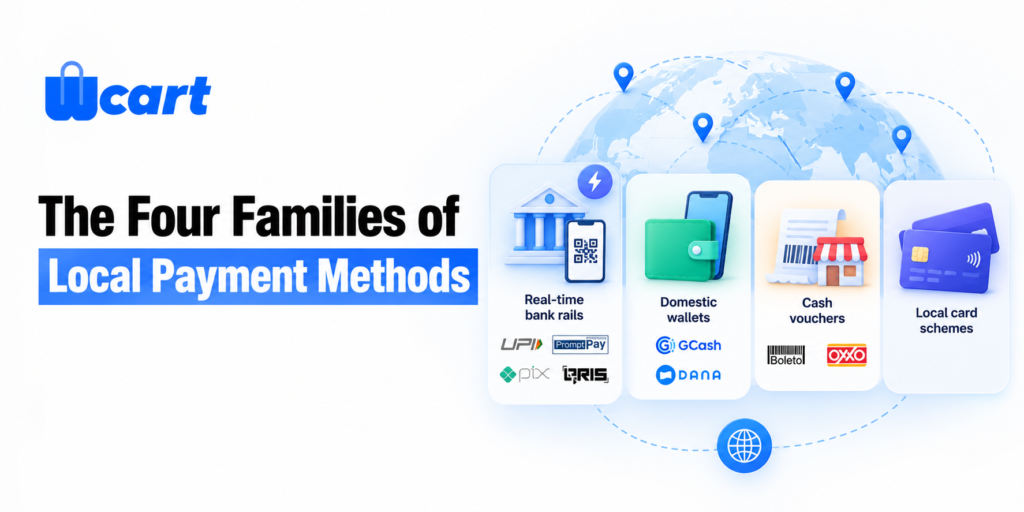
Local payment methods split into four distinct families, and each behaves differently at checkout and at fulfillment.
- Real-time bank rails – instant bank-to-bank transfers, often via QR code. Examples: UPI in India, PromptPay in Thailand, Pix in Brazil, QRIS in Indonesia. Pix alone supported over 41 billion transactions in Brazil in 2023.
- Domestic wallets – a stored balance or linked account paid from a phone app, such as GCash or DANA, dominant where they scaled early.
- Cash vouchers – buyer pays cash against a code at a store or agent, such as Boleto or OXXO. Confirmation is delayed, not instant.
- Local card schemes – domestic card networks international acquirers often can’t reach, so a locally working card can still fail at checkout.
Local coverage is a portfolio decision made market by market, weighted to where each method carries the most real volume. (Source: Banco Central do Brasil PIX Data via GR4VY)
Choosing Which Methods to Support
No business needs every method in every market. Weight coverage by where volume genuinely sits.
- Identify the one or two methods that carry the most online payment volume in each target market.
- Support the dominant method first, especially where a single rail or wallet leads by a wide margin.
- Keep cards as a sensible baseline for higher-value purchases, not the default everywhere.
Payment mix varies sharply by region: cards led at 57% of Latin American ecommerce in 2023, while cash vouchers and wallets made up the rest, and in Europe, cards sat at 43% alongside wallets at 29% and bank transfers at 24%. (Source: Worldpay Global Payments Report via GR4VY,) A short, well-chosen set of methods per market consistently outperforms one generic list applied globally.
Integrating Without a Local Entity
Accepting a domestic rail or wallet used to require a local entity and a local bank account in every market. A cross-border payment gateway removes that by combining methods and acquiring relationships behind one integration.
- Connect once through a gateway or PSP, then present the right local methods per market from that single setup. Our payment gateway setup guide walks through the process step by step.
- Look for pre-built integrations with the ecommerce software you already run, like Shopify or WooCommerce.
- Build in compliance like PCI DSS and GDPR from the start, not after methods go live.
Local Payment Methods vs. Crypto Payments
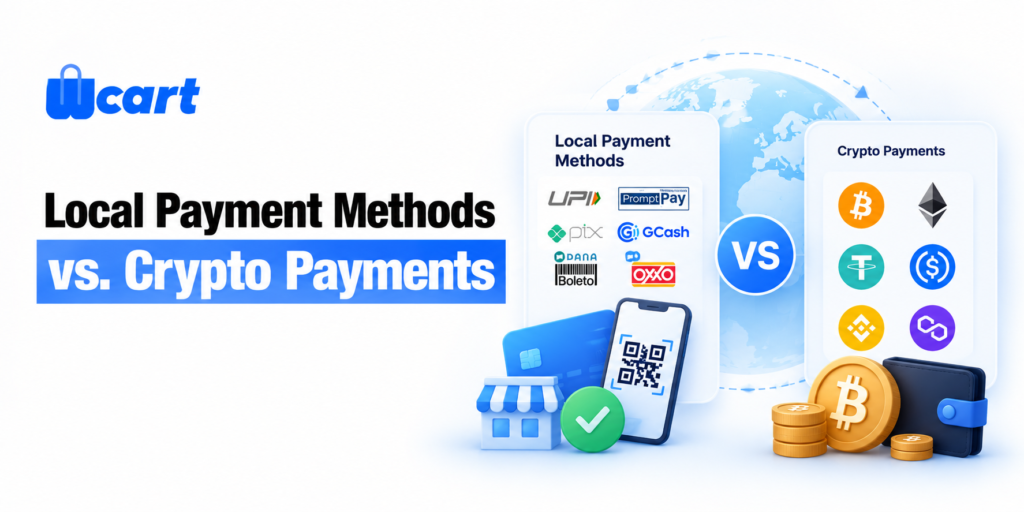
Crypto is worth considering for some merchants, but it comes with real trade-offs compared to established local methods.
- Crypto offers fast settlement, lower fees, and more transaction privacy than traditional cards.
- Value volatility and limited regional acceptance make it a harder default than local rails like UPI or Pix.
| Factor | Local Payment Methods | Crypto Payments |
|---|---|---|
| Buyer familiarity | High already part of daily life in the target market | Low to moderate still a minority habit in most consumer markets |
| Settlement speed | Instant to same-day, depending on the rail | Fast, often minutes, but varies by network congestion |
| Regional acceptance | Built for and limited to a specific market | Works globally, but adoption is uneven and often low |
| Fees | Vary by rail, generally predictable | Can be lower per transaction, but offset by conversion and custody costs |
| Best fit | Everyday ecommerce checkout in a specific country | Niche buyer segments, cross-border settlement, or merchants already holding crypto |
Crypto tends to work best as an added option, not a replacement for the local methods your core audience already expects.
Reducing Failed Payments on International Transactions
International transactions fail more often than domestic ones, and the causes are usually specific and fixable.
- Cross-border card success rates run especially low in Latin America, where most cards are built for domestic use only.
- Batch failures often trace back to a single misconfigured method or expired credential rather than a market-wide problem, so checking gateway logs before assuming it’s buyer behavior saves time.
Monitoring decline rates by method and region, and offering a local fallback, prevents a single decline from ending the sale. Since payment failures often surface right at checkout, it’s worth pairing this with our guide on reducing checkout abandonment at the payment step.
Currency Conversion and Local Pricing
Poor currency handling adds friction even when the right payment method is technically available.
- Compare exchange rates and conversion fees across gateway options before choosing one.
- Display prices in the buyer’s local currency, since 94% of cross-border shoppers expect exactly that.
Confirm your platform handles multiple currencies without manual workarounds or settlement delays.
A Closer Look: India’s UPI Market
India shows how dominant a single local rail can become, and how costly it is to ignore.
- UPI has become the default way most Indians pay online, ahead of both cards and wallets combined.
- Cross-border UPI transaction volume has grown more than 20 times in the past year, signaling that Indian payment habits are increasingly shaping demand from global sellers too. (Source: EximPe)
Merchants can now accept UPI from Indian customers through RBI-licensed cross-border aggregators, without setting up a local entity. For B2B sellers extending credit terms alongside local methods like UPI, see our guide on B2B net terms in ecommerce.
Balancing Local Coverage With Complexity
Supporting every possible method isn’t realistic, and it isn’t necessary. The goal is coverage that fits your actual markets without becoming unmanageable.
- Prioritize the top one or two methods per target market instead of trying to cover everything.
- Use a gateway that lets you add or remove methods without a full checkout rebuild.
Review method performance regularly and drop options that see little real use. If you sell across multiple vendors or regions, our multi-vendor marketplace guide covers how payment routing works at that scale.
Expand Your Global Reach With Local Payment Options
Ready to reach international buyers with a checkout that feels familiar to them? Wcart makes it easy to add the local payment methods your target markets already trust. See the full breakdown in our payments on Wcart guide.

























Leave a Reply