
Quick Answer
To accept crypto payments, integrate a digital currency gateway or a self-hosted payment server with your ecommerce platform. Merchants can choose custodial gateways that automatically convert cryptocurrency to local fiat currency to avoid volatility, or non-custodial systems that deposit digital assets directly into private merchant wallets, bypassing traditional intermediaries.
Key Takeaways
- Only 12% of North American merchants currently accept crypto at checkout, trailing even cash on delivery. (Source: EMARKETER via Merchant Risk Council)
- Nearly 4 in 10 (39%) of US merchants already accept cryptocurrency, and 84% expect it to be mainstream within five years. (Source: PayPal and National Cryptocurrency Association)
- Crypto still accounts for less than 1% of global ecommerce transaction volume, even as global ecommerce grows toward $11.7 trillion by 2030. (Source: GlobalData via The Paypers)
- 44% of consumers expect crypto to become a mainstream online payment option in the coming years. (Source: Arlington Research and Kaspersky via The Paypers)
- Among merchants already accepting crypto, digital asset payments make up 26% of their total sales. (Source: Sumsub via PayPal/NCA survey)
Traditional payment networks route every sale through multiple intermediaries, and each one takes a cut. They can also reverse a transaction weeks after you’ve already shipped the order.
For merchants selling internationally, this gets worse. High decline rates and currency conversion markups make growth expensive. Our guide on understanding payment gateway fees breaks down exactly where that cost comes from.
Crypto payments bypass the legacy banking system entirely. This guide covers how crypto transactions work, how to pick an integration path, and how to set up checkout on a self-hosted platform.
Why Should Your Online Store Accept Cryptocurrency?
Adding crypto as a payment option isn’t just for niche tech stores anymore. It’s become a practical way to cut costs and reach more buyers.
- No chargeback fraud – blockchain transactions are permanent, so there’s no bank that can claw back funds after you’ve shipped
- Lower transaction fees – crypto skips the interchange, assessment, and markup fees layered on by card networks
- Global reach without friction – a Bitcoin or stablecoin payment processes the same whether the buyer is next door or across the world
If your store already struggles with international declines, our guide to offering local payment methods to international buyers covers the card-based side of that same problem.
How Do Crypto Payments Work for Ecommerce Merchants?
To successfully implement cryptocurrency payments, it is important to understand the underlying mechanics of how these transactions move from a customer’s wallet to your business account.
How Crypto Payments Work, Step by Step
The checkout flow for a cryptocurrency payment is straightforward but differs slightly from entering a credit card number:
- Selection: The customer selects cryptocurrency as their payment method at checkout.
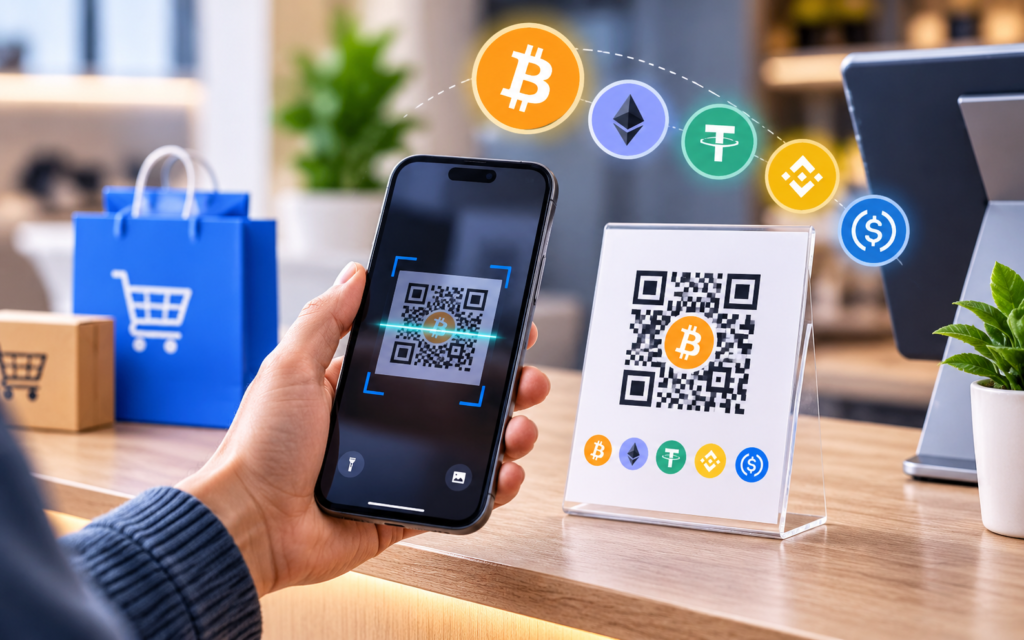
- Generation: The payment gateway generates a unique, one-time deposit address and a QR code representing that address, along with the exact amount of cryptocurrency required to satisfy the order value.
- Payment: The customer scans the QR code using their digital wallet app and authorizes the transaction.
- Verification: The transaction is broadcast to the blockchain network. The payment gateway monitors the network for confirmations.
- Completion: Once the required number of network confirmations is reached, the gateway marks the order as paid in your ecommerce backend, triggering your automated fulfillment workflow.
Custodial vs. Non-Custodial Processing
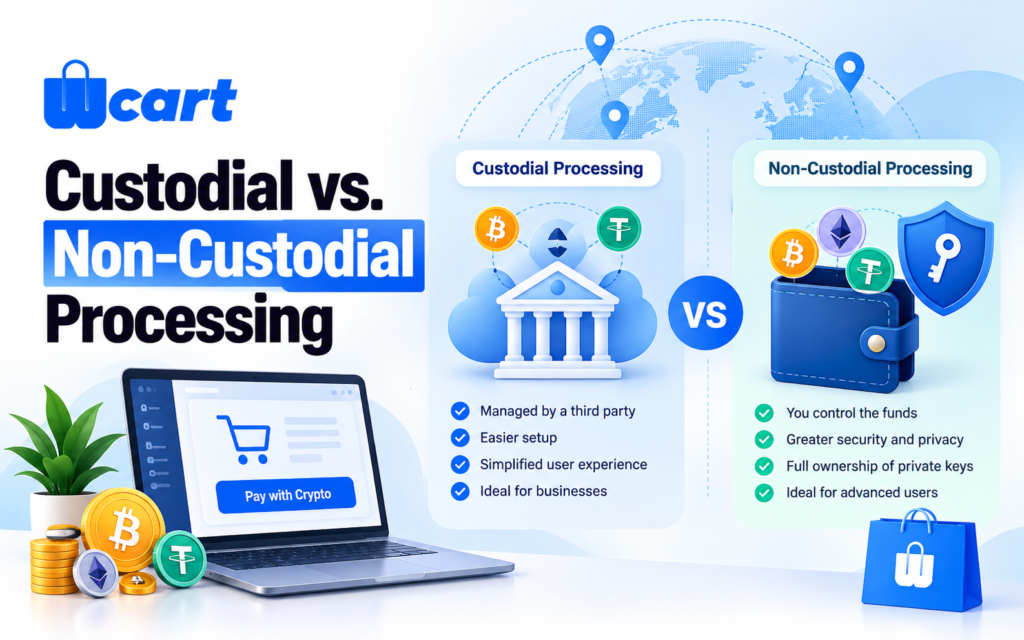
When setting up crypto payments, you must make a fundamental architectural choice: custodial or non-custodial processing.
Custodial Gateways
Custodial processors act as intermediaries, similar to traditional payment gateways. When a customer pays, the funds go to the processor’s wallet first. The processor then handles the conversion to your local fiat currency (such as USD, EUR, or GBP) and deposits the funds directly into your business bank account.
- Pros: protects against volatility, simpler accounting, no wallet management needed
- Cons: processing fees apply, requires business KYC verification
Non-Custodial Gateways
Non-custodial systems allow customers to send payments directly to a wallet that you control. There is no middleman. The software simply generates the payment addresses and monitors the blockchain to confirm when transactions are complete.
- Pros: full control of funds, minimal fees, stronger privacy
- Cons: exposes you to price volatility, requires you to manage your own keys
The 4 Main Ways to Integrate Crypto Payments?
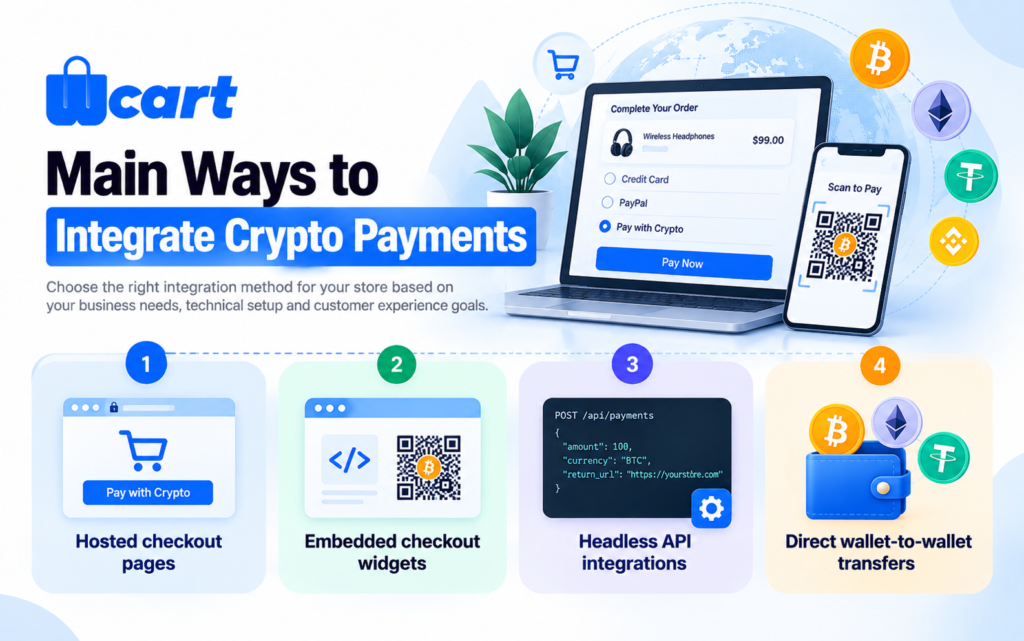
Depending on your store’s technical architecture and your desired customer experience, there are several integration methods available.
- Hosted checkout pages – customers redirect to a processor’s page to pay, then return to your confirmation page. Simplest to set up, but leaving your domain can dent conversion.
- Embedded checkout widgets – an iframe or JS widget renders the QR code right inside your existing checkout. Keeps branding consistent with moderate dev effort.
- Headless API integrations – best for brands on headless architecture, since your frontend requests a payment address via API and displays it however you design. Wcart’s headless-ready setup supports this directly through our API endpoints.
- Direct wallet-to-wallet transfers – you post a wallet address and the buyer sends funds manually. Works for low-volume, high-ticket B2B sales, but doesn’t scale for consumer storefronts.
Comparing the Top Crypto Payment Gateways
| Gateway | Type | Settlement Options | Key Strength |
|---|---|---|---|
| BTCPay Server | Non-custodial, self-hosted | Crypto only | Minimal fees, open-source, full control |
| Coinbase Commerce | Custodial & non-custodial | Crypto or fiat | Familiar brand, auto-conversion |
| BitPay | Custodial | Fiat, crypto, or stablecoins | Enterprise compliance, direct bank deposits |
| OpenNode | Custodial & non-custodial | Bitcoin & Lightning Network | Instant settlement, low fees on microtransactions |
1. BTCPay Server
BTCPay Server gives you complete control with no third-party fees, but setup requires real technical know-how and you manage your own fiat conversion.
- Pros: Complete financial sovereignty; minimal processing fees; excellent privacy; supports Bitcoin, Lightning Network, and several altcoins.
- Cons: Requires technical knowledge to set up and maintain; you must handle your own fiat conversion if you do not want to hold cryptocurrency.
2.Coinbase Commerce
Coinbase Commerce offers a familiar brand and smooth cart integrations, though custodial accounts require full KYC and fees apply to auto-conversion.
- Pros: Highly recognizable brand name; smooth integration with major shopping carts; supports automated conversion to fiat currency.
- Cons: Custodial accounts require full KYC verification; transaction fees apply to automatic conversions.
3. BitPay
BitPay suits enterprise merchants who want automated settlement into a bank account, with strong compliance tools but higher fees and stricter verification.
- Pros: Robust compliance and tax reporting tools; supports a wide range of popular cryptocurrencies and stablecoins; direct bank deposits in multiple countries.
- Cons: Higher transaction fees compared to non-custodial options; strict merchant verification processes; less control over the underlying payment infrastructure.
4.OpenNode
OpenNode focuses on Bitcoin and Lightning, which makes it a strong fit for microtransactions and digital downloads, but it won’t cover merchants wanting broad altcoin support.
- Pros: Lightning-fast transactions; low network fees; simple API integration; supports instant conversion to local fiat currency.
- Cons: Primarily limited to Bitcoin and Lightning transactions; not suitable for merchants who want to accept a wide variety of altcoins.
Common Challenges to Plan For
Accepting crypto comes with real trade-offs worth planning around before launch.
- Price volatility – Bitcoin and Ethereum can swing within a day. Automated fiat settlement locks in the exchange rate at checkout, or you can settle in stablecoins to avoid the swing entirely.
- Refund complexity – crypto transactions are irreversible, so refunds mean sending a new transaction back to the customer’s wallet.
- Exchange rate terms – state clearly in your policy whether refunds use the original fiat value or the crypto value at time of refund.
- Network fees – decide upfront whether your business absorbs the refund’s gas fee or deducts it from the customer.
For a broader look at reducing payment friction across all methods, not just crypto, see our guide on preventing failed transactions and card declines.

























Leave a Reply