
Quick Answer
To sell subscriptions online, pick one recurring model (replenishment, curation, or access), set up a billing engine that charges customers automatically, and give shoppers self-service controls to pause, skip, or cancel. Add the subscription option to your product page, connect a payment gateway that supports recurring charges, and turn on payment recovery from day one so failed cards don’t quietly become lost customers.
Key Takeaways
- The global subscription ecommerce market is projected to grow from $536.72 billion in 2025 to $859.52 billion in 2026, a 60.1% year-over-year increase. (Source: The Business Research Company, )
- 70% of subscription revenue comes from existing customers rather than new acquisition, which is why retention economics dominate this model. (Source: Swell)
- Replenishment subscriptions reach roughly 45% one-year retention, well ahead of curation-style boxes, which tend to churn faster once novelty fades. (Source: McKinsey via Xictron)
- 52% of consumers cancelled at least one subscription in the past year, most often citing lack of use rather than price. (Source: Recurly 2026 State of Subscription)
Most merchants come to subscriptions for one reason: predictable revenue. A storefront that lives sale-to-sale has to win every customer again every month, while a subscription business banks a base of recurring orders before the month even starts. This guide walks through the models, the setup steps, and the decisions that decide whether recurring revenue actually compounds or quietly leaks away.
Wcart builds and support white-label ecommerce and multi-vendor marketplace software, so this is written from hands-on platform experience.
How Do You Start a Subscription Box Business?
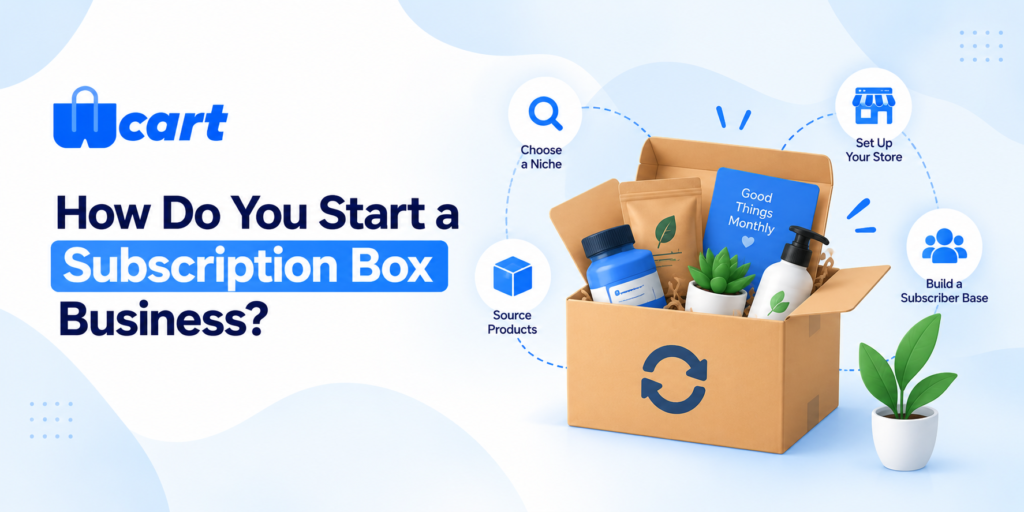
A subscription box is really a curation-model business, so the general steps below apply, with a few extras worth knowing upfront:
- Curation drives the strongest acquisition of the three models, since it’s easy to gift and share, but it also churns the fastest once novelty wears off
- Your business lives and dies on the “what’s in the box this month” reveal, so merchandising and sourcing need to be planned months ahead, not week to week
- Batch billing (charging everyone on the same day) is the norm for boxes, since it lets you pack and ship in one predictable window rather than shipping daily
How Do You Sell Subscriptions Online?
Here’s the short version of what actually needs to happen, in order, whether you’re starting from scratch or bolting subscriptions onto an existing store.
Step 1. Set up a subscription business model first, before touching any software
- Pick one model (replenishment, curation, or access) and one flagship plan. Trying to launch all three at once is the most common reason early subscription launches stall.
- Decide your pricing logic and billing cadence around that one model, since replenishment, curation, and access all price and bill differently.
Step 2. Add a subscription option to your online store
- On your product page, add a toggle or plan selector so customers can choose “subscribe and save” instead of, or alongside, a one-time purchase
- Connect a payment gateway that supports recurring charges and tokenized cards, since a gateway built only for one-time checkout won’t handle renewals cleanly
- Wire up plan and cadence options (monthly, quarterly, annual, trial) so you’re not hand-editing customer records within weeks of launch
Step 3. Give customers a self-service subscription portal
- Let shoppers pause, skip a cycle, swap products, or update a card without emailing support
- This is the single most valuable thing you can build for retention, since a customer who can’t pause will just cancel instead
Step 4. Turn on payment recovery before you need it
- Set up automatic retries, card-expiry warnings, and account-updater support from day one
- Involuntary churn starts the moment you have your first renewal, so this isn’t something to bolt on later
Step 5. Test the unhappy paths before you launch
- Failed charge, expired card, mid-cycle upgrade, pause, cancel. The happy path always works in a demo; the edge cases are what break in production once real customers show up
If you’re building this on Shopify, WooCommerce, or a similar platform, the steps above are the same, but you’ll typically need a dedicated subscription app (like Recharge or Bold on Shopify, or WooCommerce Subscriptions) to handle the billing engine and self-service portal, since most core platforms don’t include recurring billing natively.
A white-label platform like Wcart builds this in directly, so you’re not stacking a third-party app on top of your storefront.
What Are the Three Subscription Models and Which One Fits Your Product?
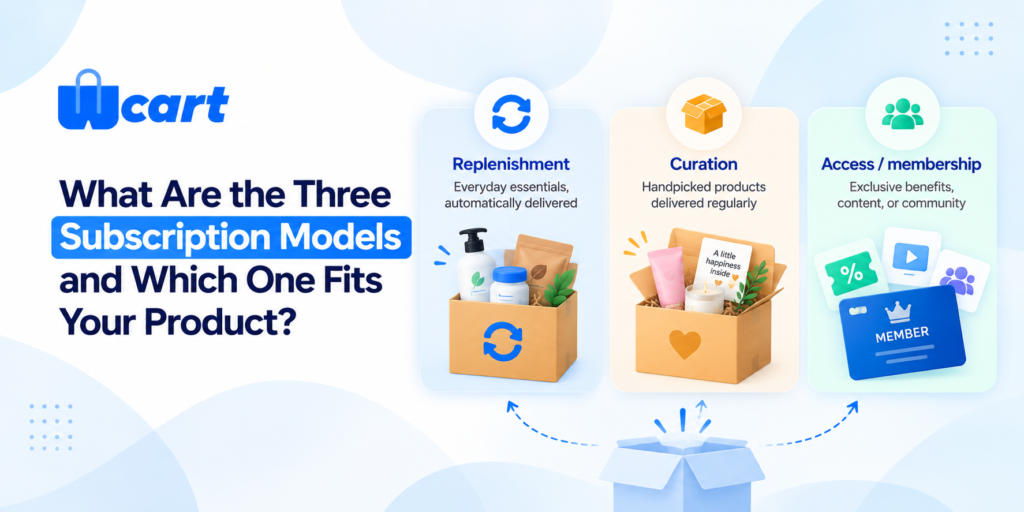
Nearly every subscription ecommerce business is a variation of three patterns. Picking the wrong one for your product is the most common early mistake, since each implies a different pricing logic, fulfillment cadence, and churn profile.
1. Replenishment – you sell something a customer runs out of: coffee, supplements, razor blades, pet food, cleaning supplies.
- Strongest natural retention, since the need is genuinely recurring
- Margins run thin, and customers stay price-sensitive
- Cadence has to match how customers actually use the product. A single 30-day default for everything leads to unopened supplement bottles piling up, and customers who don’t finish a bottle in 30 days don’t email you about it, they just quietly cancel
2. Curation – you send a changing selection each cycle: a snack box, a beauty box, a book club.
- Drives strong acquisition, since it’s giftable and fun to share
- Highest churn of the three, since novelty fades
- Lives and dies on merchandising and the “what’s in the box this month” reveal
3. Access / membership – the customer pays for ongoing access rather than physical goods: a members-only price, free shipping, exclusive drops, or digital content.
- Excellent margins, often with no per-cycle fulfillment cost
- Pairs well with a normal store as a loyalty layer
| Model | Core Promise | Typical Churn | Margin Profile | Hardest Part |
| Replenishment | Never run out | Low | Thin | Matching cadence to real usage |
| Curation | Discovery and delight | High | Variable | Keeping novelty alive monthly |
| Access / membership | Savings and status | Medium | Strong | Proving ongoing value |
What Does a Subscription Billing Engine Actually Need to Do?
The visible part of a subscription is a checkout. The part that determines whether you keep your sanity is the billing engine running behind it. At minimum, it has to handle the following without manual intervention.
How do stored payment credentials and scheduled charges work?
- You can’t ask a customer to re-enter a card every month
- The engine stores a payment token with the processor, never raw card numbers, which is what tokenization and PCI-compliant gateways exist for
- Stripe’s billing documentation is a solid reference even on a different gateway, since the core concepts (subscriptions, invoices, billing cycles) are close to universal
What plan and cadence options do you actually need?
- Real subscriptions need monthly, quarterly, and annual options, trials, prepaid terms, and proration when someone upgrades mid-cycle
- A platform that only does “monthly, forever” means you’re hand-editing records within weeks
Why does customer self-service matter so much?
- The single most valuable feature for retention
- Customers need to pause, skip a cycle, change the next ship date, swap products, and update their card themselves
- Every action that requires emailing support is both a cost and a churn risk. A customer who can’t pause will cancel instead
What about Strong Customer Authentication and regional rules?
- Selling into Europe means recurring charges interact with Strong Customer Authentication (SCA) under PSD2
- The first charge may need authentication, and the gateway then flags subsequent charges as merchant-initiated
- Getting the merchant-initiated-transaction flag wrong causes a wave of declined renewals, so it’s worth understanding PSD2 before launching in the EU
Our payment gateway setup guide covers what to check for when choosing a processor that handles this cleanly.
How Do You Price Recurring Products Without Leaving Money on the Table?
Subscription pricing is its own discipline. A one-time price optimizes for a single conversion. A subscription price optimizes for lifetime value across many cycles, which changes the math.
- Anchor on the annual plan – offer monthly and annual side by side, with annual priced at a clear discount, commonly around two months free depending on your margins. Annual subscribers churn far less, simply because the cancel decision comes up once a year instead of twelve times.
- Use trials deliberately, not reflexively – free trials and steep first-box discounts boost signups but attract deal-seekers who churn after the cheap cycle. A paid trial, a real but reduced first charge, filters for genuine intent. Test it rather than copying a competitor.
- Build in a graceful downgrade – the alternative to “cancel” shouldn’t be nothing. A cheaper tier, a longer interval, or a pause gives a wavering customer an exit that isn’t the exit. A subscriber who downgrades is still a subscriber.
Why Is Churn the Whole Game in Subscription Ecommerce?
Acquisition gets the attention, but subscription economics are dominated by retention. A business losing 8% of subscribers a month is replacing nearly its entire base every year just to stand still.
Voluntary churn – the customer chooses to leave.
- Defended against with product value, self-service options (pause beats cancel), proactive lifecycle email, and a genuine cancellation flow that offers a pause or downgrade before processing the cancel
- Honest, low-friction cancellation also keeps you on the right side of consumer-protection rules, since dark-pattern cancel flows are increasingly restricted in many regions
Involuntary churn (failed payments) – the customer wanted to stay, but their card expired, hit a limit, or was reissued.
- Pure leakage: revenue already earned, then lost to a technical decline, and it’s recoverable
- The fix is a payment-recovery process: an automated sequence that retries the charge on a smart schedule, emails the customer to update their card, and uses account-updater services that refresh expired card numbers automatically
- A chunk of monthly “churn” often isn’t customers leaving at all, it’s just cards that expired in the same window, with no email ever sent asking them to fix it
Failed payments account for roughly $440 billion in lost merchant revenue globally each year, making up 20-40% of total subscription churn in many programs. (Source: Chargebee via Xictron) We cover the full mechanics in our guide to reducing subscription churn and failed payments.
How Do You Handle Fulfillment and Operations for Subscriptions?
Physical subscriptions add an operational layer that pure-digital businesses skip. The rhythm of your fulfillment has to be designed, not improvised.
Should you use batch or anniversary billing?
- Batch billing (everyone on the same day, like the 1st of the month) concentrates fulfillment into a predictable window, easier for a small team packing boxes, but creates a demand spike for your team and shipping partner
- Anniversary billing (each customer’s signup date) smooths the workload across the month, but means shipping every day
- Most curation boxes use batch; most replenishment uses anniversary
How does subscription inventory forecasting work?
- The upside of subscriptions is knowing your baseline demand before the cycle starts
- Your active subscriber count is your floor. Forecasting against a known recurring base, plus expected new signups and churn, is far more accurate than forecasting a one-time-purchase store
How do you handle addresses and skipped cycles?
- Failed deliveries from stale addresses and forgotten skips are both retention killers
- A pre-billing reminder a few days ahead of every charge (“your next box ships in 3 days, skip or swap by Friday”) reduces disputes, returns, and angry cancellations far more than it reduces revenue
What Order Should You Roll Out a Subscription Launch In?
Once the technical setup from above is done, a few sequencing decisions matter for how smoothly the launch actually goes:
- Ship the self-service portal before you start marketing. Driving traffic to a subscription with no pause button just manufactures churn and support tickets you didn’t need to create.
- Instrument retention, not just signups. Track monthly churn, recovered failed payments, and cohort retention curves from day one. These are the numbers that actually tell you whether the business compounds.
If you’d rather not assemble billing, self-service, payment recovery, and fulfillment logic from scratch, that’s exactly the kind of recurring-commerce stack Wcart runs for merchants and multi-vendor marketplaces, white-label, on your own brand. Our recurring billing setup guide walks through the platform-side configuration, and if you’re running subscriptions across multiple vendors, see our multi-vendor marketplace guide.

























Leave a Reply