
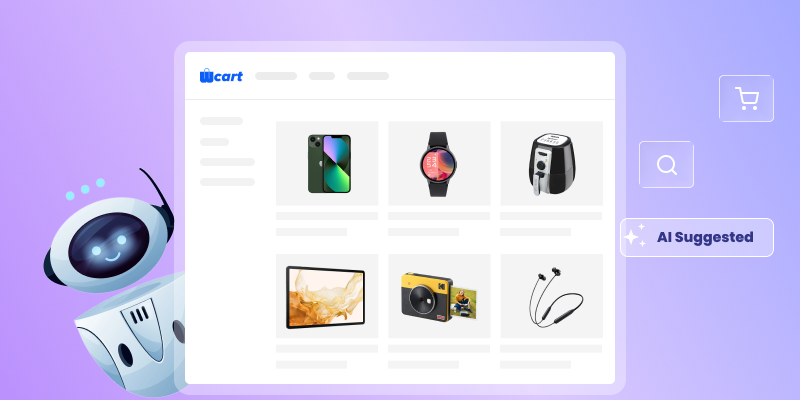
Artificial intelligence is no longer something for the future. It is already here, and it is changing ecommerce quickly.
See the practical ways AI is revolutionizing ecommerce.
From smarter search features to predictive pricing, AI tools are helping ecommerce companies save time, connect better with customers, and grow more efficiently.
Customers are also using AI more than ever. More than half of US consumers say they use ChatGPT or Gemini to search and shop online. On the business side, 95% of ecommerce brands using AI technology say they are getting good returns from their investment.
From automating customer support to giving personalized product recommendations, ecommerce AI is changing the way online stores work.
In this article, we will explore how AI in ecommerce helps businesses improve operations, create personalized shopping experiences, and grow their brand more easily.
The future of ecommerce is here—and with Wcart, it’s built with AI.
AI is bringing change to the ecommerce industry
AI in ecommerce is not just a trending feature anymore. It has become a powerful tool that is creating real impact in almost every part of a business, including marketing, logistics, and customer service.
To understand how AI technology works in your ecommerce strategy, it is important to know its main components:
- Data mining: Studying current and past data to find patterns and predict future results.
- Natural language processing (NLP): Helping computers understand and respond to human language. This technology is used in chatbots and voice search.
- Machine learning: Using algorithms and past data to make better and smarter decisions over time.
- Deep learning: An advanced part of machine learning that uses layered algorithms to find deeper insights from complex data.
As AI technology continues to grow, it has become easier for businesses to use. Today, even small ecommerce businesses are using AI tools to improve operations, reduce manual work, and increase online sales.
The rise of agentic commerce
As AI tools become more advanced, a new trend called agentic commerce is starting to grow.
Unlike traditional automation, agentic AI does more than just follow fixed rules. It can make decisions, take actions and learn from results in real time. In simple terms, it gives your ecommerce platform the ability to work smarter on its own.
From managing personalized product flows to handling backend inventory tasks, agentic commerce helps AI systems work more independently, reducing the need for constant human support.
This technology is also becoming more common. By 2028, one in three enterprise software platforms is expected to include agentic AI features, showing a big change in how ecommerce companies manage operations and serve customers.
Even though it is still developing, agentic commerce has the potential to completely change the online storefront by making it smarter, faster and more self optimizing.
Read more: what is ecommerce and how it works
Benefits of using artificial intelligence in ecommerce companies
Leading ecommerce companies like Amazon have been using AI technology for years to improve customer experiences, simplify logistics, and support business growth. Today, AI for ecommerce is not only for large tech companies, it is helping businesses of all sizes achieve real results.
AI tools can help businesses improve customer satisfaction, increase revenue, and reduce operational costs by more than 25%. From better product recommendations to faster customer support and smarter inventory management, the benefits are easy to see.
As ecommerce businesses continue to stay competitive, AI provides powerful solutions that support marketing, fulfillment, and daily operations while improving efficiency on a larger scale.
1. More targeted marketing and advertising
AI in marketing helps ecommerce brands move beyond general campaigns and create personalized, data-driven experiences that improve conversions.
Personalization is important for many ecommerce businesses, but not all brands have successfully implemented it at scale. This is where AI for ecommerce becomes valuable. By studying customer behavior, purchase history, and engagement patterns, AI tools help businesses deliver the right message to the right customer at the right time.
The result is stronger brand visibility. In fact, 81% of marketers say AI has helped improve brand awareness.
With machine learning and predictive analytics, ecommerce companies can use customer data to create messaging that feels more personal and less promotional.
2. Increased customer retention
Personalized experiences do more than increase clicks — they help build customer loyalty.
AI-powered personalization allows ecommerce companies to customize their messaging based on customer behavior, preferences and timing. This level of personalization helps create stronger customer relationships and encourages repeat purchases.
Businesses using AI to provide personalized communication see up to a 30% increase in customer retention. By turning customer insights into action, AI tools help brands stay relevant, build trust, and keep customers returning.
3. Seamless automation
Automation helps businesses complete more work with less manual effort and AI makes automation even smarter.
For ecommerce companies, AI automation can manage time consuming tasks such as product recommendations, loyalty program triggers and customer support routing. These AI tools allow teams to focus more on business strategy instead of repetitive tasks.
As ecommerce technology continues to improve, AI is helping online stores operate more efficiently. This includes inventory management, personalized discounts and handling customer inquiries at scale.
4. Efficient sales process
AI tools do more than attract customers they also help businesses close sales faster.
By automating lead scoring, tracking buyer intent, and providing real time insights, AI helps shorten the sales cycle and improve performance across the sales funnel. Ecommerce businesses using AI for sales operations can reduce sales cycle times by up to 25% and lower operational costs by as much as 60%.
This means teams spend less time on manual work and more time focusing on valuable customer conversations. With AI supporting your sales strategy, your team can work faster, respond smarter and scale more efficiently.
AI use cases in ecommerce
There are many use cases in ecommerce for AI and you may already know some of them. However, you might not realize that the technology behind them is powered by AI. Here are some of the most common use cases:
- Personalized product recommendations
- Pricing optimization
- Enhanced customer service
- Customer segmentation
- Smart logistics
- Sales and demand forecasting
- Agentic commerce
- Agentic checkout
- Optimizing for generative search engines
1. Personalized product recommendations
AI in ecommerce makes it easier to provide personalized product recommendations that increase conversions and improve order value.
By studying customer data such as past purchases, browsing activity and shopping behavior, machine learning models can predict what customers are most likely to buy next. This helps ecommerce companies show relevant products in real time, improving the shopping experience and boosting sales performance.
As AI tools become easier to use, even growing brands can access advanced personalization without needing strong technical knowledge.
Read more: How AI Product Recommendations Can Boost Your Ecommerce Store
2. Pricing optimization
AI enabled dynamic pricing is a method of changing product prices based on supply and demand.
With the right data, AI tools can predict when discounts are needed and calculate the minimum discount required to complete a sale.
3. Enhanced customer service
With virtual assistants and chatbot technology, businesses can provide faster and more responsive customer support.
Although chatbots are not completely independent, they can handle simple tasks and transactions, allowing live support agents to focus on more complex customer issues.
Virtual agents are also available 24/7, helping customers get answers anytime without waiting for support teams.
4. Customer segmentation
Understanding customers is important for creating personalized and effective shopping experiences and AI makes this process easier and faster.
Using AI tools, ecommerce companies can segment customers based on behavior, interests, purchase history and more. These customer segments help businesses send the right promotions, product recommendations and messages to the right audience at the right time.
Unlike manual segmentation, AI powered customer segmentation updates continuously using real time data. This helps marketing campaigns stay relevant and perform better with less manual effort.
5. Smart logistics
Delivering products quickly and efficiently is essential for ecommerce success and AI helps improve every stage of the process.
With AI tools, ecommerce businesses can optimize shipping routes, predict delivery delays and manage inventory more accurately. Real time data and predictive analytics help reduce costs, improve delivery speed and increase customer satisfaction.
AI in ecommerce logistics also supports warehouse automation, demand forecasting and returns management, helping businesses create a smoother and more scalable fulfillment process.
6. Sales and demand forecasting
Accurate forecasting helps businesses manage inventory, plan promotions, and meet customer demand effectively. AI improves the speed and accuracy of these predictions.
By using historical data, market trends, and real-time insights, AI tools can identify patterns and forecast future sales and demand more accurately than manual methods. This helps reduce overstock and stock shortages while improving profitability.
With AI in ecommerce, demand forecasting becomes more proactive, helping businesses make better decisions in operations, marketing, and supply chain management.
7. Agentic commerce
Agentic commerce is the next stage of AI in ecommerce. These AI systems do more than assist businesses they can also take action.
Unlike traditional automation, agentic AI tools can make decisions, perform tasks, and learn from results with very little human input. In ecommerce, this includes tasks like pricing updates, inventory reordering and product bundling based on customer behavior and business goals.
As this technology grows, ecommerce businesses can use agentic AI to build smarter online stores that continuously improve themselves. This creates a more flexible and intelligent shopping experience.
8. Agentic checkout
Agentic checkout uses AI to make the checkout process faster, smarter, and easier for customers.
Instead of using fixed checkout steps, agentic systems adjust in real time based on customer behavior, preferences, and shopping intent. For example, they can automatically apply loyalty rewards, suggest upsell products, or simplify checkout for returning customers.
By reducing friction and understanding customer needs, agentic checkout helps improve conversion rates and reduce cart abandonment for ecommerce businesses.
9. Optimizing for generative search engines (GEO)
As generative AI becomes more common in search platforms, ecommerce businesses need to change the way they approach SEO.
Generative engine optimization (GEO) uses large language models to create direct answers and product recommendations within search results. Because of this, users may rely less on traditional links and more on AI-generated search summaries. To stay visible, ecommerce companies must optimize product data, content, and metadata for these AI-powered search experiences.
This includes using structured data, conversational keywords, and clear product descriptions. By adapting to how GEO platforms display information, ecommerce businesses can improve visibility and remain competitive in modern search results.
Read more: risks of AI in ecommerce
How to implement artificial intelligence into ecommerce
It can be exciting to start using new technologies, but it is important to have a clear plan before implementing AI. A proper roadmap helps ecommerce businesses avoid wasting time and money on the wrong solutions.
1. Create a strategy
Every successful AI project starts with a clear strategy. Your strategy should define the steps needed to achieve your AI goals.
Instead of leaving all decisions only to an AI expert, CIO or CTO, businesses should carefully think about what they want to achieve with AI. Take a practical approach and start with smaller projects first. As you see positive results, you can expand your AI efforts over time.
2. Find narrow use cases that are relevant to the overall corporate strategy
The best AI use cases are connected to business goals, valuable data, and proven artificial intelligence models.
This means ecommerce businesses should focus on opportunities that can increase revenue, especially in areas where they already have strong customer data and where AI technology is already effective.
3. Leverage third-party expertise
Even if your team understands AI well, expert support can still make a big difference.
Businesses can work with external AI specialists or project teams to help create a strong AI roadmap. Third party experts can also help build an MVP (minimum viable product) and guide the business during the early stages of implementation.
4. Build a full-scale solution
Once your team is confident with the results, the next step is to build a full scale solution.
It is normal for AI systems to require multiple improvements and adjustments before they work perfectly. As your team gains more experience with AI, you will begin to see stronger results and greater business value from the projects you implement.
Want to know: About best Ecommerce Order Management Systems
The final word
Artificial intelligence is no longer just an optional technology upgrade. It is becoming an important part of how ecommerce companies grow faster, personalize customer experiences, and compete in an AI-driven market.
Across the ecommerce industry, AI tools are helping businesses improve operations, reduce costs, and create new revenue opportunities. AI adoption is also increasing rapidly. According to McKinsey & Company, more than 78% of companies now use generative AI in at least one part of their business, compared to 55% the previous year.
For ecommerce businesses, the message is clear. Whether the goal is improving personalized experiences, increasing operational efficiency, or making smarter business decisions, now is the right time to invest in AI.
By starting with strategic AI use cases and scaling gradually, ecommerce companies can take full advantage of this technology and build a smarter online storefront for the future.

























Leave a Reply