
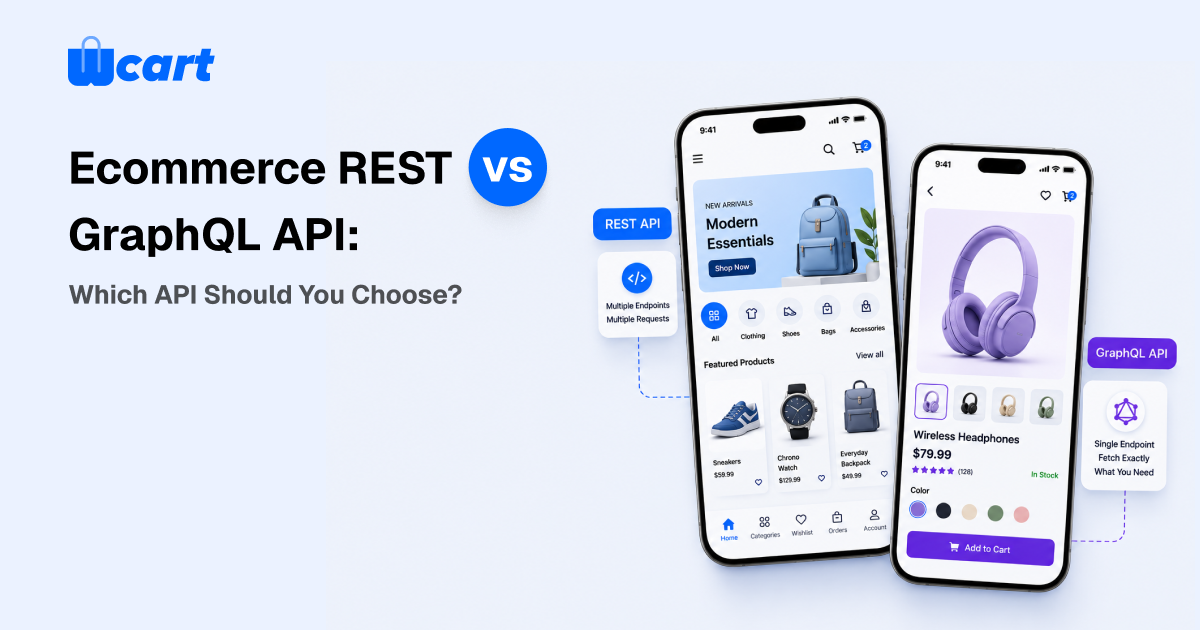
For most ecommerce stores, the choice between REST and GraphQL API isn’t really about which is “better.” It comes down to the shape of your data and who’s consuming it. Reach for a REST API when you want simple, cacheable, well-understood endpoints: webhooks, server-to-server integrations (ERP, accounting, shipping), and third-party apps that expect predictable URLs.
Reach for GraphQL when a rich front end (a headless storefront, a mobile app, a custom dashboard) needs to pull deeply related data like product, variants, inventory, reviews, and recommendations in one round trip, without over- or under-fetching. In practice, mature ecommerce platforms expose both. So the real decision is per integration, not a one-time architectural bet. This guide walks through when each one wins, trade-offs and all.
By the Wcart team, we build and support white-label ecommerce and multi-vendor marketplace software, so this is written from hands-on platform experience.
The “ REST vs GraphQL API” debate tends to get framed as a religious war, but the teams that ship fast treat it as a toolbox decision. Both are just ways to move JSON between your store’s data and the things that consume it. What differs is how the request is shaped, how caching works, and how much control the client gets over the response. Below we break down each one, then hand you a decision framework you can actually apply.
What a REST API is, in ecommerce terms
REST (Representational State Transfer) organizes your data as resources reached through predictable URLs and standard HTTP verbs. In a store, that looks like GET /products, GET /products/123, POST /orders, PATCH /inventory/456. Each endpoint returns a fixed JSON structure. It’s the lingua franca of the web. Every developer, every HTTP client, every monitoring tool, and almost every third-party app you’ll ever integrate already speaks it.
Where REST shines for stores
- Caching. Because a
GETto a stable URL returns the same thing, you can cache it at the CDN, the reverse proxy, or the browser using ordinary HTTP cache headers. For product catalogs and category pages, which are read-heavy and slow-changing, this is a huge, almost free performance win. - Webhooks and server-to-server. When your store pushes an
order.createdevent to a fulfillment service, or your accounting system polls for new invoices, simple stable endpoints are exactly what you want. See our guide on using ecommerce webhooks for real-time order and stock sync. - Third-party expectations. Payment gateways, shipping APIs, tax engines and marketplace connectors are overwhelmingly REST. Matching that convention cuts down on glue code.
- Observability. Each endpoint is its own line in your logs and metrics. It’s trivial to see that
/checkoutis slow without untangling a single catch-all query.
Where REST hurts
The classic problems are over-fetching and under-fetching. A product-detail page might need the product, its variants, current stock, the active promotion, and the top three reviews. With REST that can mean four or five separate requests (under-fetching, where you have to ask again and again), and each one may return more fields than you use (over-fetching, wasting bytes on mobile).
On a high-latency mobile connection, those extra round trips add up fast. Teams work around it with custom “composite” endpoints, but here’s what actually happens: every composite endpoint is bespoke code someone has to own, and six months later nobody remembers why /product-page-bundle-v2 returns the fields it does.
What a GraphQL API is, in ecommerce terms
GraphQL is a query language for your API. Instead of many endpoints, you usually have one (/graphql), and the client sends a query describing exactly the fields it wants, across related objects, in a single request. Ask for a product plus its variants plus inventory plus reviews, and you get back precisely that shape, nothing more. The API is defined by a strongly typed schema, which doubles as living documentation. GraphQL is governed by an open specification stewarded by the GraphQL Foundation; you can read the official spec at graphql.org.
Where GraphQL shines for stores
- Rich, relational front ends. A
- or native mobile app can hydrate a whole screen with one query. Fewer round trips usually means a snappier perceived experience, especially on mobile.
- Client controls the payload. The mobile team can request a lean set of fields while the web team requests more, from the same endpoint, with no new backend work. This decoupling is why GraphQL pairs naturally with headless commerce.
- Strong typing and introspection. The schema tells clients what exists and what type it is. Tooling can autocomplete queries and catch mistakes before they ship.
- Evolves without versioning. You add fields without breaking old clients, and deprecate gracefully, instead of cutting
/v1,/v2endpoints.
Where GraphQL hurts
The flip side of flexibility is operational weight. HTTP caching is harder because requests are typically POSTs to one URL with the query in the body. Your CDN can’t cache them the easy way, so you lean on application-level or persisted-query caching instead. Performance can hide: a single innocent-looking query can fan out into dozens of database hits (the “N+1” problem), so you need DataLoader-style batching and query-cost limits.
A malicious or careless client can request a deeply nested query that hammers your database, which means you have to enforce depth and complexity limits. And observability is coarser, since everything is one endpoint. You instrument at the resolver and operation-name level, not the URL level. None of this is fatal. It’s just real work.
REST vs GraphQL API: side-by-side
| Dimension | REST | GraphQL |
|---|---|---|
| Endpoints | Many, resource-based URLs | Usually one (/graphql) |
| Response shape | Fixed per endpoint | Defined by the client query |
| Over/under-fetching | Common; needs composite endpoints | Largely solved by design |
| HTTP caching | Easy (GET + cache headers + CDN) | Harder (POST to one URL); needs app/persisted-query caching |
| Round trips for a complex screen | Often several | Often one |
| Versioning | Explicit (/v1, /v2) | Schema evolution, deprecation |
| Learning curve / tooling | Low; universal | Higher; needs schema + resolver discipline |
| Best-fit consumer | Webhooks, ERP/accounting, partner apps | Headless storefront, mobile, custom dashboards |
| Main risk to manage | Endpoint sprawl, chatty clients | N+1 queries, query-cost abuse |
A decision framework you can actually use
Skip the ideology. Ask these questions per integration:
1. Who is the consumer?
If it’s a machine on a server (your ERP, your accountant’s software, a shipping label service, a webhook receiver), lean REST. These consumers want stable, documented, cacheable endpoints and rarely need to cherry-pick fields. If it’s a human-facing client that paints complex screens (a headless React/Vue storefront, an iOS/Android app, an internal merchandising dashboard), GraphQL’s single-query convenience pays off.
2. How relational is the data you fetch together?
Flat, isolated reads (give me one order, give me one product) are perfectly happy on REST. Deeply nested reads are a different story: give me this collection, with each product’s variants, each variant’s inventory across warehouses, plus reviews and related products. That’s where GraphQL earns its keep, collapsing a request waterfall into one call.
3. How important is edge caching?
For anonymous, read-heavy catalog traffic, REST plus CDN caching is hard to beat and cheap to operate. If your traffic is mostly authenticated and personalized (so it can’t be cached at the edge anyway), that REST advantage shrinks and GraphQL’s payload efficiency starts to look better.
4. What does your team actually know?
Be honest about operational maturity. GraphQL done badly, with no query-cost limits and no batching, is slower and more fragile than plain REST. If you don’t have the appetite to run depth limits, persisted queries, and resolver-level monitoring, REST is the safer default. Google’s own performance guidance (see web.dev) is consumer-agnostic, but the principle holds: the fastest API is the one your team can operate correctly under load.
The honest answer: it’s usually “both”
In real stores you rarely pick one and ban the other. A common, pragmatic split:
- REST for the integration layer: webhooks, ERP and accounting sync, payments, shipping, partner/third-party apps. (For wiring those up, see how to connect your store to an ERP or accounting system.)
- GraphQL for the experience layer: your headless storefront, mobile app and custom admin dashboards where rich, client-shaped reads matter.
This is why most serious commerce platforms, including an enterprise ecommerce platform how we think about exposing data in Wcart, offer REST endpoints and a GraphQL layer, and let each integration use whichever fits. The architectural skill isn’t choosing a winner. It’s matching the tool to the consumer and keeping both well-governed.
Migration and coexistence notes
If you have a REST API today and a front-end team asking for GraphQL, you don’t have to rip anything out. A frequent pattern is to put a thin GraphQL layer in front of existing REST services or the database: the storefront talks GraphQL, while your back-office integrations keep their stable REST contracts.
Just budget for the GraphQL guardrails up front (query depth/complexity limits, batching to kill N+1, and persisted queries so your CDN can cache common operations). The one thing you don’t want to do is retrofit those after a traffic spike, when a single unbounded query is already taking the database down and you’re patching limits at 2 a.m. instead of designing them in calmly.
Frequently asked questions
Related guides
- Headless Commerce Implementation: A Step-by-Step Guide (cluster hub)
- Using Ecommerce Webhooks for Real-Time Order & Stock Sync
- How to Connect Your Store to an ERP or Accounting System
Building a store that has to talk to everything? Explore Wcart, a white-label ecommerce and multi-vendor marketplace platform built to expose clean APIs for your storefront, your mobile app, and your back-office systems alike.

























Leave a Reply