
Quick Answer : Bulk product import with a CSV lets you add or update many products at once using a spreadsheet file, instead of entering each one by hand. Upload your file, map its columns to the right fields, then import. A test batch of 5-10 rows first catches errors before they hit your whole catalog.
Key Takeaways
- CSV import saves hours on catalogs with more than a handful of products one file replaces hundreds of manual entries.
- The SKU is the match key. It’s what tells the system whether a row creates a new product or updates an existing one.
- A 5-10 row test batch catches problems early, before you commit an error to your whole catalog.
- UTF-8 encoding prevents the most common failure: garbled special characters in product names and descriptions.
- Variant products need a parent-child structure. Get the parent reference wrong, and variants become orphaned, standalone products instead of options on one listing.
Bulk product import is an easy way to add or update multiple products at once using a CSV file, instead of entering each product manually.
Manually adding products works when you only have a small number of items.But as your catalog grows, it quickly becomes slow and increases the chances of mistakes, such as typos in SKUs, mismatched category names, prices entered in the wrong currency format. A well-built bulk product import csv workflow solves all of that.
It can also do real damage if you treat the import button as a magic wand. This guide walks through how to import products at scale without corrupting the catalog you already have.
What a CSV product import actually does
- A CSV file stores product data in a simple table.
The first row contains the column names, and each row after that represents a single product. - The platform reads each row during the import.
It matches the columns with the correct product fields, such as name, price, SKU, and stock. - The SKU or Product ID tells the system what to do.
If it matches an existing product, the platform updates it. If not, it creates a new product. - Keep your SKUs unique and consistent.
Duplicate or incorrect SKUs can create duplicate products or overwrite the wrong ones during import.
Create vs. update: know which one you’re doing
- Before you touch a file, decide your intent. Are you adding brand-new products, refreshing prices and stock on existing ones, or both? A pricing refresh should only include the SKU plus the columns you want to change.
- Sending blank columns can wipe descriptions or images on platforms that interpret empty as “set to empty.” A new-product import needs the full set of required fields. Mixing the two in one careless file is how catalogs get damaged.
Build a clean CSV before you import anything
- The fastest way to a clean import is to never start from a blank sheet. Export an existing product (or the platform’s sample template) so you inherit the exact column names and order the importer expects. Then fill your data into that structure.
Required vs. optional columns
- Every platform has a minimum set of fields a product needs to exist. The rest are optional but heavily influence merchandising and SEO. Here is a typical breakdown.
| Column | Required? | Common mistakes |
|---|---|---|
| SKU | Yes | Duplicates, trailing spaces, changed between imports |
| Product name / title | Yes | Commas not quoted, inconsistent casing |
| Price | Yes | Currency symbols, thousands separators, text formatting |
| Stock / quantity | Usually | Decimals, blanks read as zero |
| Category | Recommended | Name not matching an existing category exactly |
| Description | Optional | Line breaks and HTML breaking the row structure |
| Image URL | Optional | Local paths instead of public URLs, broken links |
| Variant / parent SKU | If variable | Orphaned variants, no shared parent reference |
Formatting rules that prevent silent corruption
- Save as UTF-8. Encoding is the most under-appreciated cause of broken imports. If accented characters, currency symbols, or non-Latin scripts turn into garbled text, your file was saved in the wrong encoding. UTF-8 is the safe default. See the W3C explainer on character encoding for why this matters.
- Quote fields that contain commas. A description like “Soft, breathable cotton” will split into two columns unless the field is wrapped in double quotes. Most spreadsheet apps do this automatically on export. Problems creep in when people hand-edit the raw CSV.
- Strip currency symbols and separators from numbers. Prices should be plain decimals like
19.99, not$19,99or1.299,00. The importer wants a number, not a formatted string. - Keep SKUs as text. Spreadsheets love to “helpfully” strip leading zeros or convert long numeric SKUs to scientific notation. Format the SKU column as text before you paste.
The official RFC 4180 CSV specification is the closest thing to a standard for the format, and it explains the quoting and line-break rules that most importers follow.
The safe import workflow, step by step
This is the sequence we recommend to every merchant, whether they’re importing 50 products or 50,000. It exists to make damage reversible and to catch errors while they’re still cheap to fix.
- Back up your current catalog. Export everything you have now to a CSV and save it somewhere safe. This is your rollback file. If an import goes wrong, you re-import this to restore.
- Start from a template. Export a sample product to get the exact column headers, then build your data into that structure.
- Map your columns. During upload, the platform asks you to match each CSV column to a product field. Do this carefully. A mis-mapped column is how prices end up in the stock field.
- Run a 5-10 row test batch. Never validate against your full file. Import a tiny slice first, then open those products in the admin and check that images, price, variants, and category all landed correctly.
- Review the error report. A good importer tells you which rows failed and why. Fix the source spreadsheet, not the products one by one.
- Import the full file. Once the test batch is clean and the mapping is saved, run the complete import.
- Spot-check and reconcile. Compare your expected product count to the actual count, and sample a handful of products across categories.
The discipline that matters most is the test batch plus the backup. Together they turn a scary irreversible action into a routine one. This mirrors the broader principle in our ecommerce catalog management guide: never make a bulk change to a live catalog without a way to undo it.
Which Platforms Make Bulk Import Easiest?
Import tooling varies a lot by platform. Here’s how the major ones compare:
- Wcart follows the same test-batch, clear-error-report approach covered in this guide, built directly into the platform rather than added on. See the full walkthrough below.
- Shopify is usually considered the easiest of the major platforms. It has a built-in field-matching UI, gives per-row error feedback before committing the import, and handles remote image URLs reasonably well.
- BigCommerce is close behind Shopify native CSV import, decent error reporting though variant handling (the parent-child pattern covered above) trips people up more often than on Shopify.
- WooCommerce is the most finicky of the mainstream platforms, mainly because bulk import isn’t native. It depends on a plugin, and quality varies a lot depending on which plugin and version you’re running.
- Wix has the weakest bulk import tooling of the group. It exists, but it’s more limited on variant handling and error visibility than the others.
How Bulk Import Works on Wcart (Step by Step)
Here’s what the process actually looks like inside Wcart, using the same principles covered in this guide: clean files, a test batch, and clear error reporting.
Step 1: Open Import from Your Dashboard
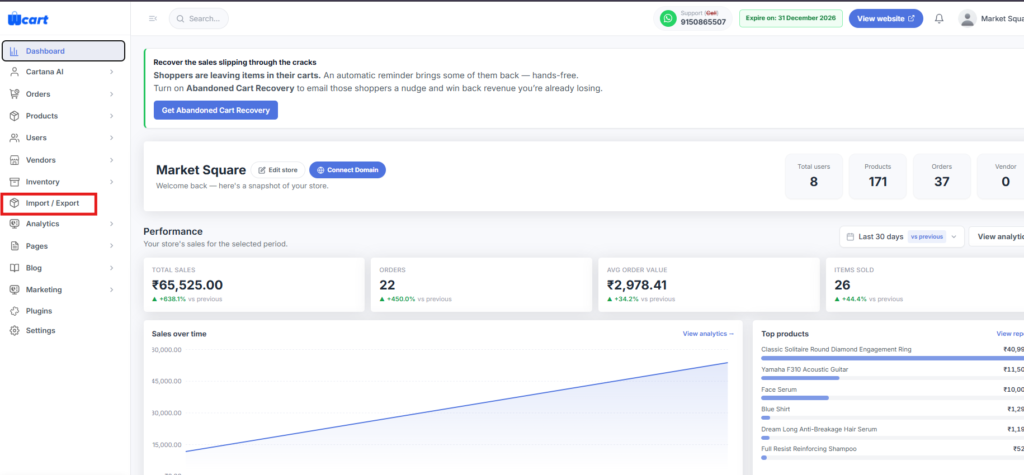
- Go to Import / Export in the left-hand menu.
- Choose the Products tab (Categories, Tags and Brands can also be imported the same way).
- Download the Sample CSV first if this is your first import — it shows the exact column names Wcart expects.
Step 2: Upload Your CSV
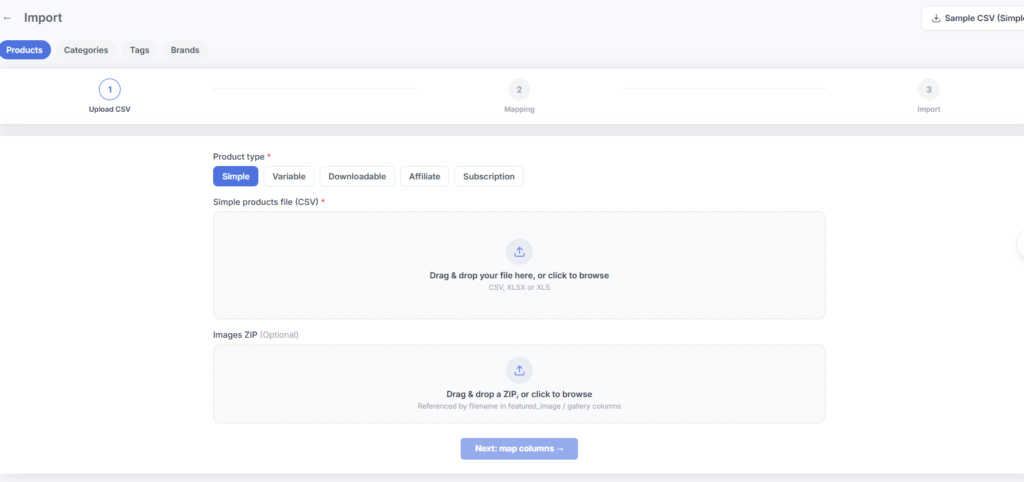
- Pick your product type: Simple, Variable, Downloadable, Affiliate or Subscription.
- Drag and drop your file, or click to browse. Wcart accepts CSV, XLSX or XLS, so you don’t have to convert an Excel file to CSV first.
- Optionally upload an Images ZIP alongside it. Image files inside the ZIP are matched to products by filename, using the
featured_imageorgallerycolumns in your sheet.
Step 3: Map Your Columns
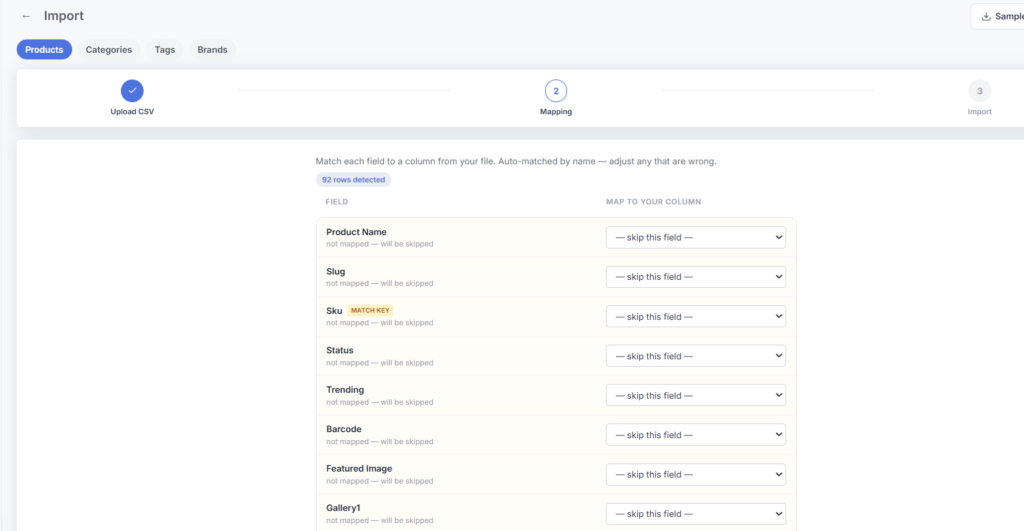
- Wcart shows every expected field Product Name, Slug, SKU, Status, Trending, Barcode, Featured Image, Gallery, and more next to a dropdown for the matching column in your file.
- It tells you upfront how many rows it detected (for example, “92 rows detected”), so you can confirm that against your source file before going further.
- SKU is flagged as the match key. This is the field Wcart uses to decide whether a row updates an existing product or creates a new one get this mapping right, or you risk creating duplicates instead of updates.
- Any field you don’t map is skipped, not guessed, so double-check nothing important is left on “skip this field.”
Step 4: Import and Review the Results
- Wcart runs the import and shows a clear summary: Created, Updated, and Skipped counts.
- If any rows fail, Wcart tells you exactly how many and why, for example, “16 rows couldn’t be imported (missing or invalid fields).”
- Download the error report CSV to see the specific reason for each failed row, fix just those rows, and re-upload. You don’t need to redo the whole file.
- Use “Preview reasons” to check common issues before downloading, if you just want a quick look.
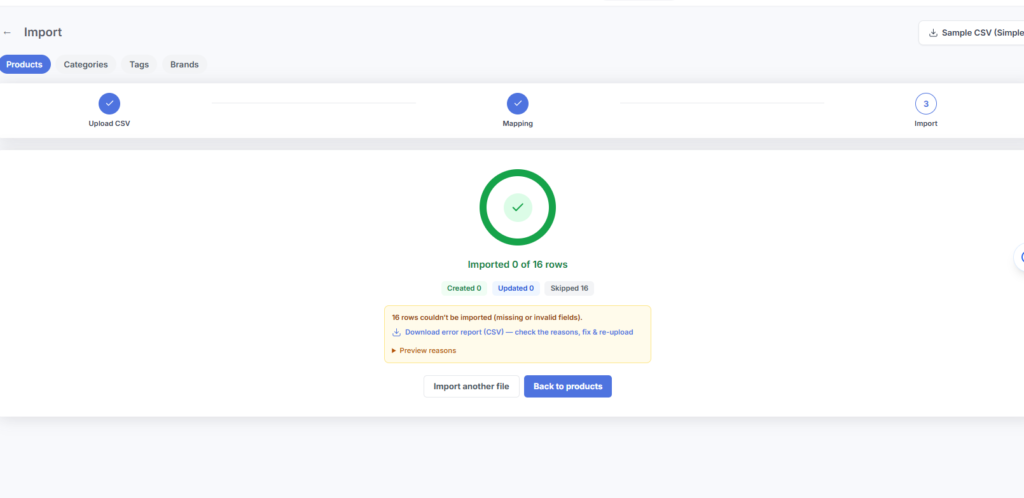
This is the same safe-import pattern covered earlier in this guide map carefully, test small, read your errors built directly into Wcart’s import tool rather than something you have to manage yourself with a separate spreadsheet or plugin.
Migrating your whole store, not just adding products? Bulk import handles the product data. If you’re moving your entire catalog from another platform, our ecommerce migration guide covers the rest: redirects, customer data, and keeping your SEO rankings intact during the switch.
What breaks catalogs, and how to avoid it
| Symptom | Likely cause | Fix |
|---|---|---|
| Garbled characters in names | Wrong encoding | Re-save the file as UTF-8 |
| Products merged into one | Duplicate SKUs | De-duplicate the SKU column before import |
| Duplicate products created | SKUs changed between imports | Keep SKUs stable; treat them as permanent IDs |
| Descriptions or images wiped | Blank columns in an update file | Only include columns you intend to change |
| Variants appear as separate products | Missing parent reference | Add a consistent parent SKU to every child row |
| Prices import as zero or text | Currency symbols / formatting | Use plain decimal numbers |
| Rows silently skipped | Missing required field | Check the error report; fill required columns |
Frequently asked questions
Bring it all together
A bulk product import is one of the highest-leverage operations in running a store. It turns hours of manual data entry into a single upload. The merchants who never have a bad import day all do the same few things: they start from a template, keep SKUs stable, save as UTF-8, test a small batch, and keep a rollback file. If you want a platform where import, variants, and multi-location stock are built to work together cleanly, take a look at Wcart.

























Leave a Reply