
Quick Answer
A UGC campaign encourages real customers to create and share content, like photos, videos, and reviews, about a product they’ve actually used.
- It works because people trust other people more than they trust a brand talking about itself.
- Brands featuring UGC on product pages see conversion lifts as high as 161%
Building one well means giving customers a clear reason to participate, a simple way to share, and a real plan for where that content shows up next.
Key Takeaways
- 80% of consumers trust user-generated content more than traditional advertising. (Source: Salesgenie)
- 40% of shoppers won’t complete a purchase if a product page has no user-generated content at all. (Source: Smash Balloon)
- 80% of Gen Z say UGC is crucial to their purchase decisions, making it the primary product-discovery layer for the highest-spending younger cohort. (Source: Bazaarvoice Sepia)
Customers already trust other customers more than they trust you. That’s not a knock on your brand, it’s just how people make decisions now. A UGC campaign is simply the structured effort to capture that existing trust and put it somewhere it can actually work, on your product pages, in your ads, and across social.
This guide covers what a UGC campaign actually is, real examples from brands that have made it work, how to build and measure one, and the legal groundwork most guides skip entirely.
What Is a UGC Campaign?
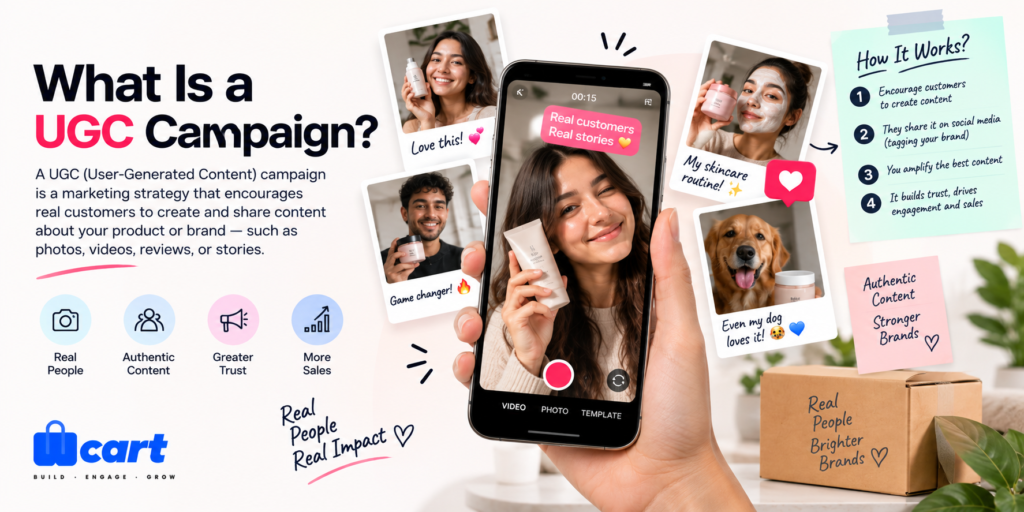
User-generated content is any photo, video, review, or post created by an actual customer, not the brand, about a product or experience they genuinely had. A UGC campaign is the deliberate structure a brand builds around collecting, featuring, and amplifying that content.
- A review is UGC in its simplest form
- A photo or video a customer posts using your product, tagged or untagged
- A testimonial submitted directly through a form or landing page
- Social posts created organically, without a brand ever asking for them
The difference between UGC happening naturally and a UGC campaign is intent. Random mentions occur whether you plan for them or not. A campaign gives customers a specific reason and a specific place to create that content, and a specific way you’ll use it afterward.
Real UGC Campaign Examples Worth Studying
Abstract advice about UGC is easy to find. What’s harder to find is proof it actually works. Here are real, verifiable examples with real outcomes attached.
NAVY Hair Care

NAVY Hair Care built its entire brand around visible customer content, combining photos, videos, and detailed reviews across its site and social channels. The result: a 264% increase in repeat-visit rate and website engagement after championing UGC as a core strategy, not an afterthought. (Source: HubSpot)
The Cosmopolitan of Las Vegas

The Cosmopolitan of Las Vegas blends influencer content with genuine guest photos across category pages, from restaurant shots to casino floor moments. That approach has driven over 250 million impressions, contributing directly to both engagement and site traffic. (Source: HubSpot)
Crocs
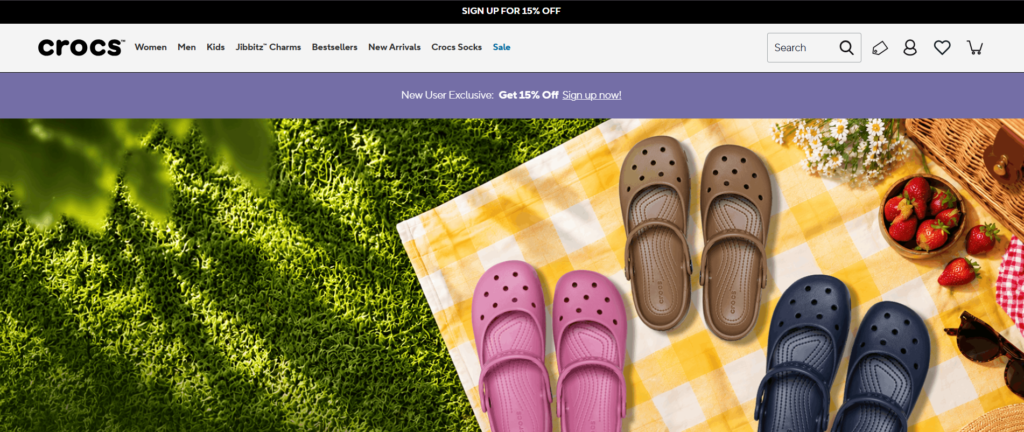
Crocs invites its community to share how they style their shoes using the hashtag #MyCrocsEra, turning an already-massive customer base into an ongoing content engine that reinforces purchase confidence and retention.
Article

Article, an online-only furniture brand with no physical showrooms, solves its biggest structural problem (customers can’t see furniture in person before buying) by displaying real customer photos directly on product pages, alongside a dedicated shoppable inspiration gallery.
Jones Soda

Jones Soda took UGC further than most brands would consider, letting fans submit photos for a chance to have them printed on an actual bottle label, with site visitors voting on submissions. This turned customer content into the product’s own packaging.
How Do You Encourage Customers to Create UGC?
Getting customers to actually participate takes more than asking nicely. A few approaches consistently work better than a generic “share your photos” request.
- Give a clear, specific call-to-action – a branded hashtag, a tag requirement, or a simple submission form works far better than a vague invitation
- Offer a real incentive – a discount, a chance to be featured, or entry into a giveaway gives customers an actual reason to spend the extra minute
- Use social listening tools – to catch UGC that’s already happening organically, then engage with and amplify it rather than starting from zero
- Make sharing genuinely easy – the fewer steps between “I love this” and “I posted about it,” the more content you’ll actually get
- Feature customers publicly and consistently – brands that visibly showcase customer content see more customers volunteer content in return, since being featured is its own reward
Kyle Wong, Chief Strategy Officer at Emplifi, frames the starting point simply: the first question isn’t how to generate more UGC, it’s what you’re doing with the positive content customers are already creating. Most brands don’t have a real system for collecting it in the first place. (Source: HubSpot interview with Kyle Wong)
How Do You Build a UGC Campaign Strategy?
A strategy here means having a specific plan for collection, amplification, and follow-through, not just posting a request and hoping something comes back.
Step 1 — Build a repository. Set up one central place to collect and store customer content: reviews, photos, testimonials, social mentions. Without this, valuable content sits scattered across support tickets, comments, and DMs where marketing never sees it.
Step 2 — Decide where the content will actually live. A social repost is the minimum viable use. A dedicated gallery, a product page feature, or a landing page built specifically to showcase customer content does far more work, since UGC placed directly on product pages is what drives the conversion lift.
Step 3 — Give customers a clear call-to-action. A specific hashtag, a tagging requirement, or a submission form turns scattered mentions into a trackable, aggregatable campaign.
Step 4 — Feed insights back into the business. Real customer content is also real customer research. Recurring themes in UGC can inform product development, positioning, and even what to fix.
Step 5 — Handle the legal side before content goes live, covered in full detail below, since this is the step most guides skip and the one that creates real risk if ignored.
What Are the Best UGC Campaign Ideas by Platform?
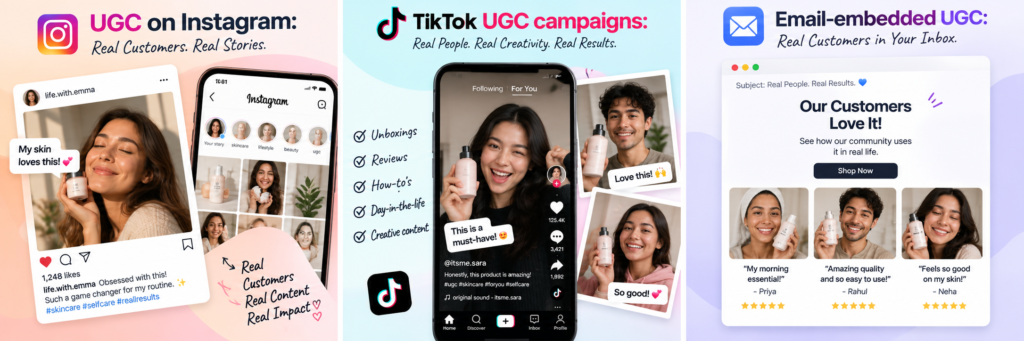
Different platforms reward different formats, so a single UGC strategy rarely performs identically everywhere.
- UGC on Instagram: works best through Stories reposts, a dedicated Highlights collection for customer content, and a branded hashtag customers can tag into. Static photo UGC still performs strongly here, especially on product pages linked from Instagram Shopping.
- TikTok UGC campaigns: favor short, authentic video over polished photography. TikTok UGC content drives 59% higher engagement than the platform average, which makes it one of the strongest formats for this specific channel. (Source: Buzzinly) Our guide on TikTok marketing and TikTok Shop for ecommerce brands covers how to structure content specifically for that platform’s algorithm.
- Email-embedded UGC: email campaigns that include user-generated content see a 78% higher click-through rate than those without it. (Source: Buzzinly) If you’re building out your list to support this, our guide on essential email list building strategies covers the capture side of that equation.
UGC vs. Influencer Marketing: What’s the Real Difference?
These two get grouped together constantly, but they’re built on different mechanics and earn different levels of trust.
| Factor | User-Generated Content | Influencer Marketing |
| Who creates it | Regular customers, unpaid | Paid or gifted creators with an existing audience |
| Trust level | 86% of consumers trust a brand more when it uses UGC over influencer content | Lower direct-response trust; only 12% say they’d buy based on an influencer promotion |
| Cost | Often free or low-cost (discount, feature, small incentive) | Can range from low-cost micro-influencer deals to significant fees for larger creators |
| Best for | Building trust, social proof, product page conversion | Reach, awareness, tapping into an existing built-in audience |
| Scale | Naturally scales as your customer base grows | Requires ongoing spend to maintain reach |
(Source: Sepia)
How Do You Measure UGC Campaign ROI?
Measuring this well means tracking both engagement and the metrics that tie directly back to revenue.
- Conversion rate lift – compare product pages with UGC displayed against pages without it. Brands using UGC see 29% more web conversions than campaigns without it. (Source: Wiserreview)
- Revenue per visitor – shoppers who engage with UGC generate meaningfully higher revenue per visitor than those who don’t, since engagement itself signals stronger purchase intent
- Average order value – UGC engagement has been shown to lift average order value by roughly 13% (Source : Smash Balloon )
- Time on site and bounce rate – a strong signal UGC is doing its job even before a purchase happens, since customers spend longer engaging with real content than with static brand imagery
- Repeat visit and retention rate – NAVY Hair Care’s 264% increase is the clearest example of UGC’s impact extending well past a single purchase decision
Track these against a genuine control (pages or campaigns without UGC) rather than in isolation, since the comparison is what actually proves the lift.
How Do You Handle the Legal Side of a UGC Campaign?
This is the part most UGC guides skip entirely, and it’s the part that creates real risk if it’s ignored.
- Get clear rights before reposting. A public post doesn’t automatically give you the right to reuse it in ads or on your website. Ask directly, or use a platform’s official reposting terms.
- Be upfront in your campaign terms. If you’re running a hashtag campaign or a giveaway, state clearly what happens to submitted content and how it may be used.
- Understand giveaway regulations. If incentives are involved, giveaway rules vary by state and platform, and running afoul of them can create real legal exposure.
- Disclose sponsored relationships. If any portion of your UGC involves paid or gifted product, proper disclosure isn’t optional in most regions.
- Keep records of permissions granted, especially for content used in paid advertising, where rights requirements tend to be stricter than organic reposting.
A quick legal consult before launching a UGC campaign with incentives attached is a small cost against the risk of skipping it entirely.

























Leave a Reply