
Quick answer:
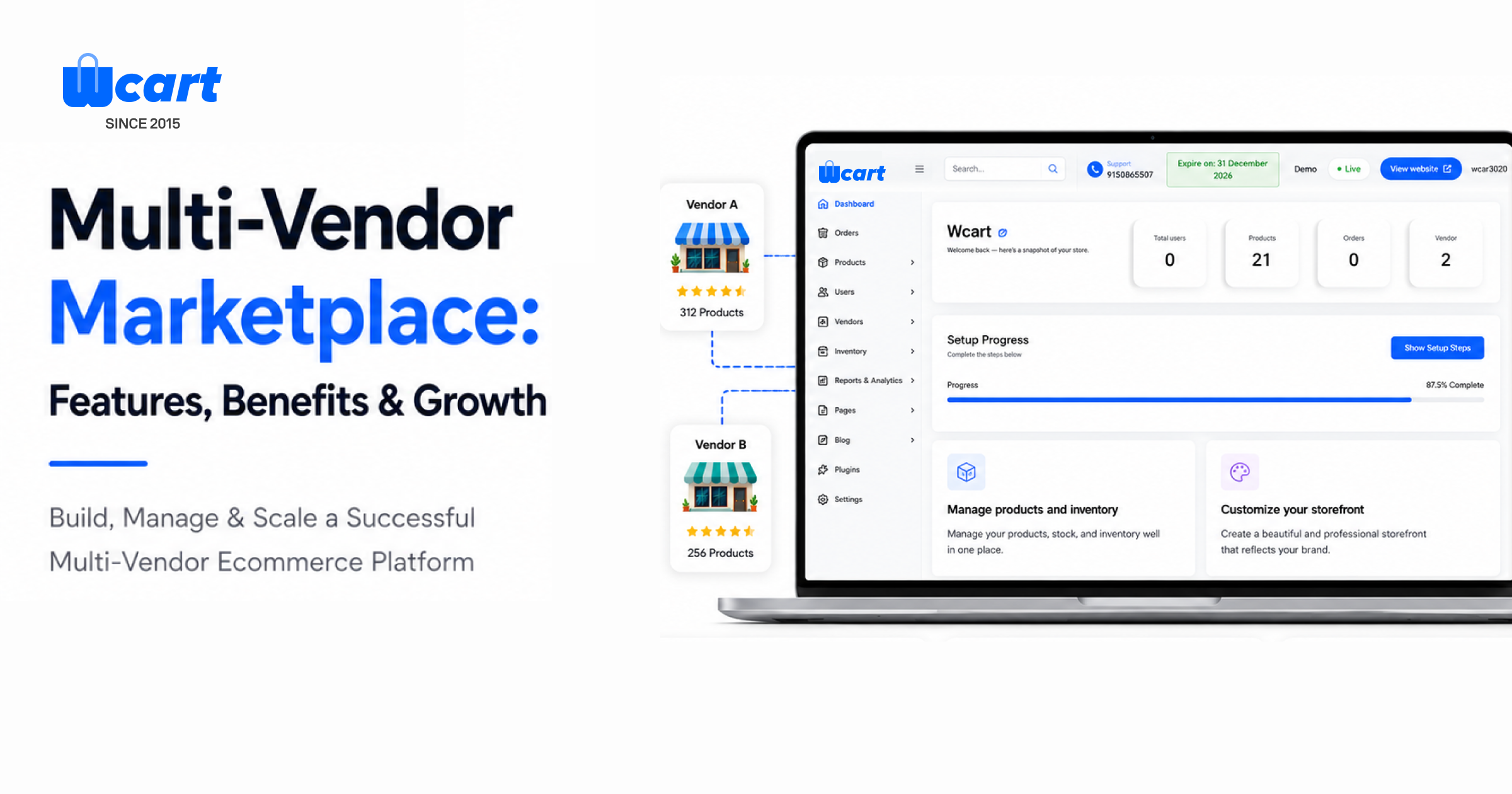
A multi-vendor marketplace is a single online platform where multiple independent sellers list and sell their own products, while the platform owner handles the site, payments, and vendor management. Amazon and Etsy are well-known examples. Wcart builds multi-vendor marketplace software for businesses launching their own version of this model, from niche marketplaces to large-scale platforms.
Running an online store used to mean sourcing every product yourself. A multi-vendor marketplace changes that: multiple sellers list and manage their own products on one shared platform, while the platform owner handles payments, vendor onboarding, and the overall shopping experience. This model now dominates online retail.
According to Forrester’s 2025 marketplace research, marketplaces account for 63.5% of all online sales, ahead of direct-to-consumer stores. That share keeps climbing as more brands move away from single-vendor setups. Consumers want choice, competitive pricing, and fast delivery without hopping between sites, and a single-vendor store struggles to deliver all three at once.
This model is behind some of the biggest online businesses ever built, and it’s still growing. If you’re considering building a marketplace, niche or large, this guide covers how the model actually works.
Key Takeaways
- Marketplaces now account for 63.5% of all online sales(Source: Forrester, 2025, making them the dominant ecommerce format ahead of single-retailer stores. (Source: Forrester, 2025),
- The B2B marketplace segment alone held over 58% revenue share in 2024, and the wider ecommerce platform market is growing at a 20.2% CAGR, driven mainly by the shift to multi-vendor models.(Source: Swell, 2026),
- North America’s marketplace GMV is estimated at $1.1 trillion in 2026, more than double Europe’s $420 billion, with Amazon alone holding 37.6% of U.S. ecommerce and 60–62% of its own sales coming from third-party sellers. (Source: CS-Cart, 2026)
- Marketplaces make up more than 60% of total U.S. ecommerce sales, with vertical and niche marketplaces expanding faster than general ones.(Source: Yo!Kart, 2026)
- Global ecommerce marketplace sales are projected to hit approximately $7 trillion in 2026, with Amazon alone capturing 37.8% of total online sales share.(Source: SQ Magazine, 2026).
What Is a Multi-Vendor Marketplace?
Instead of one business selling everything, a Multi-Vendor Marketplace brings together multiple sellers on a single platform. Each seller can manage their own products and orders, while customers can browse, compare, and purchase items from different vendors without having to visit multiple websites.
How It Works
The marketplace owner provides:
- The platform
- Customer acquisition
- Payment infrastructure
- Vendor onboarding
- Marketplace management
The vendors handle:
- Product listings
- Inventory management
- Pricing
- Order fulfillment
- Customer support (depending on the marketplace model)
The result is a collaborative ecosystem where all participants benefit
| Marketplace Owner | Vendors | Customers |
| Expands catalog without inventory investment | Gains access to a larger audience | Gets more product choices |
| Earns commissions and recurring revenue | Reduces marketing costs | Enjoys competitive pricing |
| Scales faster with more sellers | Focuses on selling products | Shops from multiple sellers in one place |
How Does a Multi-Vendor Marketplace Work?
A successful marketplace follows a structured workflow that allows vendors and customers to interact efficiently.
1. Vendor Registration and Approval
Businesses or individual sellers apply to join the marketplace.
Marketplace administrators can:
- Approve vendors automatically
- Review applications manually
- Verify seller credentials
- Assign vendor categories
This ensures quality control and helps maintain trust across the platform.
2. Product Listing and Catalog Management
Once approved, vendors can:
- Add products
- Upload images
- Create descriptions
- Set pricing
- Manage stock levels
- Define shipping settings
A well-organized catalog improves customer discovery and conversion rates.
3. Customer Browsing and Purchasing
Customers can:
- Search products
- Filter categories
- Compare vendors
- Read reviews
- Add products from multiple sellers to one cart
- Complete purchases through a unified checkout
The shopping experience remains simple even though multiple vendors are involved.
4. Order Management and Fulfillment
After a purchase:
- Vendors receive order notifications
- Inventory updates automatically
- Shipping information is processed
- Tracking details are shared with customers
- Returns and exchanges can be managed efficiently
5. Payment Processing and Commission Distribution
The marketplace collects customer payments and distributes earnings based on predefined rules.
Common commission models include:
- Percentage-based commissions
- Fixed transaction fees
- Vendor subscription plans
- Category-specific commission rates
- Hybrid revenue models
This creates predictable revenue for the marketplace owner while maintaining flexibility for sellers.
Why Businesses Are Choosing Multi-Vendor Marketplaces
The core appeal is that growth doesn’t depend entirely on the platform owner’s own inventory or supplier relationships.
A traditional single-vendor store is often limited by inventory investment, supplier relationships, warehouse space, and sourcing. A multi-vendor marketplace removes most of that. Every new vendor brings new products, new customers, new category expertise, and a new revenue stream, without the marketplace owner having to source or stock a single item themselves.
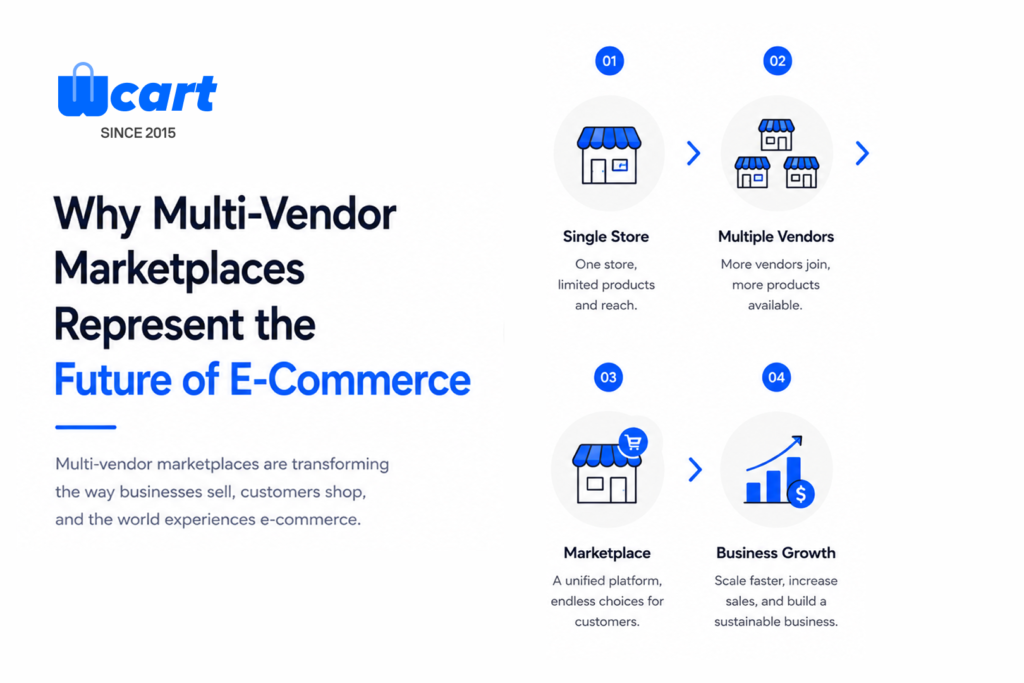
The growth loop looks like this: more vendors join, which increases product selection, which brings in more customers, which creates more sales opportunities, which attracts more vendors. It’s a self-reinforcing cycle, and it’s a big part of why marketplace businesses tend to scale faster than single-vendor stores.
The Marketplace Growth Loop
- More vendors join the platform.
- Product selection increases.
- More customers visit the marketplace.
- Sales opportunities improve.
- Additional vendors want to join.
- The marketplace grows organically.
This self-reinforcing cycle is one reason why marketplace businesses scale faster than many traditional online stores.
Key Features of a Successful Multi-Vendor Marketplace
Not all marketplace platforms are created equal. To support long-term growth, businesses need a robust Multi Vendor E-Commerce Platform with the right capabilities.
1.Vendor dashboard – Sellers need to manage products, inventory, orders, revenue reports, customer communication, and performance data without needing to contact support for routine tasks. A dashboard that requires hand-holding for basic operations creates support overhead that scales badly.
2. Product management system — Vendors need to add and edit products, organize categories, upload media, manage pricing, and track stock accurately. Bad product data is one of the fastest ways to lose customer trust on a marketplace.
3. Order management — Real-time order tracking, shipment updates, delivery monitoring, return handling, and cancellation workflows all need to work smoothly for both vendors and administrators, not just one side.
4. Commission management — Marketplace owners need to set global commission rules, vendor-specific rates, category-based commissions, and promotional fee structures. Rigid, one-size-fits-all commission settings tend to push good vendors toward competitor platforms.
5. Secure payment integration — Multiple payment gateways, secure transactions, automated vendor payouts, refund handling, and payment reconciliation all directly affect whether vendors and customers trust the platform.
6. Vendor storefronts — Individual seller pages let vendors build their own identity within the marketplace, which supports stronger branding, better product presentation, and more repeat purchases.
7. Ratings and reviews — Reviews build credibility, improve transparency, and push sellers toward better service. Buyers are far more likely to purchase when they can actually evaluate a seller’s track record.
8. Analytics and reporting — Revenue reports, vendor performance metrics, product insights, customer behavior data, and commission tracking give the marketplace owner what they need to make real growth decisions instead of guesses.
Benefits of a Multi-Vendor Marketplace for Business Owners
1.Faster Catalog Expansion
- Instead of sourcing every product yourself, vendors continuously add new inventory to the marketplace.
- This dramatically increases product variety without increasing operational burden.
2.Reduced Inventory Costs
Because vendors manage their own stock, marketplace owners avoid:
- Warehousing expenses
- Inventory risk
- Overstock issues
- Product sourcing challenges
3.Multiple Revenue Streams
A marketplace can generate revenue through:
- Sales commissions
- Subscription fees
- Featured listings
- Sponsored products
- Advertising placements
- Premium seller memberships
This diversification strengthens long-term profitability.
4.Increased Customer Retention
- Customers prefer platforms that offer variety and convenience.
- The larger your marketplace catalog becomes, the more reasons customers have to return.
5.Greater Scalability
- Traditional e-commerce businesses often grow linearly.
- Marketplace businesses can scale exponentially because growth comes from both customer acquisition and vendor expansion.
Benefits for Vendors
1.Access to traffic they didn’t have to build.
- Getting a new ecommerce site in front of buyers from scratch takes real time and marketing spend. A marketplace hands vendors an existing audience from day one.
2.Lower startup costs.
- Vendors can start selling without building a website, managing hosting, or investing heavily in their own marketing.
3.Simpler day-to-day operations.
- Integrated tools for products, orders, inventory, and reporting mean less time on admin and more time on actually growing sales.
4.Shared marketing reach.
- Marketplace owners typically invest in SEO, paid ads, social, and content at the platform level. Every vendor benefits from that visibility without paying for it directly.
Benefits for Customers
1.More Product Choices
- Customers can browse thousands of products from multiple vendors in one place.
2.Better Pricing
- Vendor competition tends to push toward more competitive pricing, exclusive deals, and regular promotions.
3.Convenient Shopping
- Comparing products, sellers, reviews, and pricing without hopping between different websites.
4.Greater Trust and Transparency
- Secure payments, verified sellers, and public reviews give buyers what they need to make an informed decision before purchasing.
Industries That Benefit Most from Multi-Vendor Marketplaces
The marketplace model is highly adaptable and works across virtually every industry.
Popular Marketplace Categories
- Fashion and apparel
- Electronics
- Home and furniture
- Beauty and cosmetics
- Health and wellness
- Food and grocery
- Automotive parts
- Handmade goods
- Digital products
- Professional services
- Wholesale and B2B commerce
Businesses can build either broad marketplaces or highly specialized niche platforms.
Common Challenges When Building a Multi-Vendor Marketplace
Build a Multi Vendor Marketplace While the marketplace model offers significant advantages, businesses should be aware of common challenges.
Vendor Quality Control
Maintaining consistent standards across multiple sellers requires:
- Vendor verification
- Product moderation
- Performance monitoring
- Customer feedback systems
Dispute Resolution
Marketplaces need clear policies for:
- Returns
- Refunds
- Delivery issues
- Customer complaints
Vendor Acquisition
Launching a marketplace requires balancing both sides of the ecosystem:
- Attracting sellers
- Attracting buyers
Without vendors, customers have limited choices. Without customers, vendors have little incentive to join.
Operational Complexity
As the marketplace grows, managing payments, commissions, logistics, and compliance becomes increasingly important.
The right Marketplace Software helps automate these processes and reduce administrative workload.
How to Choose the Right Marketplace Software
When evaluating an E-Commerce Marketplace Solution, look for:
Essential Features Checklist
✔ Vendor onboarding and approval
✔ Product catalog management
✔ Order management tools
✔ Flexible commission structures
✔ Secure payment integrations
✔ Mobile responsiveness
✔ Reporting and analytics
✔ SEO capabilities
✔ Multi-language support
✔ Scalability for future growth
Choosing software that supports long-term expansion prevents costly migrations later.
Why Multi-Vendor Marketplaces Represent the Future of E-Commerce
Consumer behavior continues to shift toward platforms that offer:
- Convenience
- Variety
- Competitive pricing
- Faster purchasing decisions
At the same time, businesses are looking for growth models that reduce inventory risk while increasing revenue opportunities.
A Multi Seller Marketplace successfully addresses both needs.
By creating a platform where buyers and sellers can interact efficiently, businesses can build scalable ecosystems that become stronger as participation increases.
This combination of scalability, flexibility, and recurring revenue is why marketplace businesses continue to dominate modern e-commerce.
Ready to Build Your Marketplace?
Wcart’s marketplace tools handle vendor onboarding, commission management, and payment processing in one dashboard, so you’re not stitching together separate plugins to run a multi-vendor store. Book a free marketplace consultation to walk through what a build would actually look like for your catalog and vendor model.
Conclusion
A Multi-Vendor Marketplace is more than an e-commerce model—it’s a scalable business strategy.
Multivendor E-commerce platform By bringing multiple sellers together on a single platform, businesses can expand product offerings, create recurring revenue streams, reduce inventory risks, and deliver a better customer experience.
As online commerce continues to evolve, marketplace-driven businesses are uniquely positioned to grow faster, adapt more efficiently, and create lasting competitive advantages.
For entrepreneurs and businesses looking to build a sustainable online ecosystem, investing in a Multi-Vendor Marketplace can be one of the smartest growth decisions you make.
Frequently Asked Questions (FAQs)
What is a Multi-Vendor Marketplace?
A Multi-Vendor Marketplace is an e-commerce platform that allows multiple independent sellers to sell products through a single website. The marketplace owner manages the platform, while vendors manage their own inventory, products, and orders.
How does a Multi-Vendor Marketplace make money?
Marketplace owners typically generate revenue through sales commissions, vendor subscriptions, featured listings, advertising opportunities, transaction fees, and premium seller services.
What is the difference between a marketplace and a traditional online store?
A traditional online store sells products from a single business. A marketplace allows multiple vendors to sell products through one platform, creating a larger product catalog and more revenue opportunities.
Is a Multi-Vendor Marketplace suitable for startups?
Yes. Startups can begin with a small group of vendors and gradually expand. The marketplace model is highly scalable and can grow alongside the business.
What industries can use a Multi-Vendor Marketplace?
Common industries include fashion, electronics, furniture, beauty, groceries, automotive, wholesale, digital products, and professional services.
What features are essential in marketplace software?
Essential features include vendor management, product management, commission settings, order processing, payment integration, reporting tools, analytics, customer reviews, and mobile-friendly functionality.
How do I start a marketplace website?
Start by selecting a reliable marketplace platform, defining your business model, onboarding vendors, setting commission rules, configuring payment systems, and launching a customer acquisition strategy.
Which industries work best for a multi-vendor marketplace?
Fashion, electronics, home goods, beauty, groceries, automotive parts, handmade goods, digital products, and B2B wholesale are the categories that show up most often, though the model works in nearly any category with enough independent sellers.

























Leave a Reply