

Quick answer: Diwali ecommerce 2026 runs on a short clock. Amazon’s Great Indian Festival and Flipkart’s Big Billion Days started on October 8, and Diwali is on November 8. Small Indian sellers should use marketplaces for reach, grow an opt-in WhatsApp list, and send all campaign traffic to one Diwali page on their own store. Then measure the season by repeat buyers, not order count.
Every October, Indian sellers get the same deal from the festive season: huge demand, thin margins, and a customer list that belongs to someone else. This year, there is time to change the last part.
Amazon’s Great Indian Festival started on October 8, 2026. Flipkart’s Big Billion Days opened early access on October 8 for Plus, Black and Flipkart credit card members, with general access from October 9. Diwali falls on November 8. That gives you roughly a month of peak buying intent.
This guide is not about squeezing one more discount out of your listings. It is about using the next 30 days to leave the season with something marketplaces never hand over: customers who can buy from you again, directly.
Key Takeaways
- Marketplaces are for reach. Keep selling there, and follow their rules on contacting buyers.
- WhatsApp is for permission. Message only people who opted in.
- Your own store is for ownership. Send every campaign to one Diwali page you control.
- Discount less. Bundles, free-shipping thresholds and early access protect margin better than flat sitewide cuts.
- Measure what stays. Own-store share, new opt-ins and 60-day repeat rate tell you if the season built your business.
What Is One Festive Order Worth to You?
Most sellers measure Diwali by order count. A better measure is what each order leaves behind. Here is an illustrative comparison for a ₹1,000 product (replace these numbers with your own fees and costs):
| Marketplace order | Own-store order | |
|---|---|---|
| Selling price | ₹1,000 | ₹1,000 |
| Platform / gateway fees (illustrative) | ₹180–₹250 | ₹20–₹30 |
| Shipping | Often platform-set | You choose the partner |
| Customer contact you keep | Masked or none | Name, phone, email (with consent) |
| Chance to sell again directly | Low | High |
Illustrative figures only. Marketplace fees vary by category, price band and fulfillment model.
In short, the margin gap matters, but the last two rows matter more. A marketplace order is a sale. An own-store order is a sale plus a relationship.
How Should Each Sales Channel Work During Diwali?
Sellers struggle when every channel is asked to do everything. Give each one a single job:
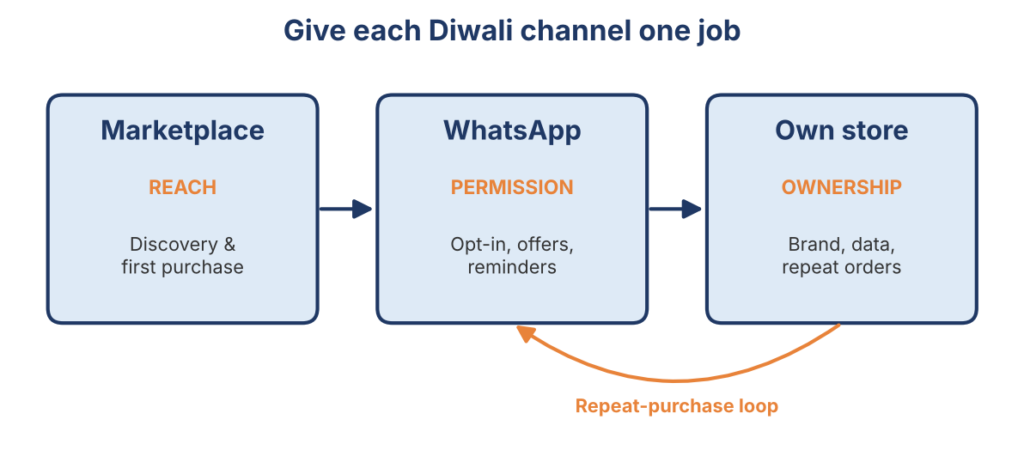
- Marketplaces rent you attention. Use them for discovery, volume and clearing stock during the sale window. Play by their rules and keep your ratings strong.
- WhatsApp earns you permission. It is where a shopper agrees to hear from you again: offers, restocks, delivery updates.
- Your own store keeps the relationship. It is the one place where the brand, the pricing, the offers and the customer data are fully yours.
The bottom line: marketplace = reach, WhatsApp = permission, own store = ownership. Plan your Diwali campaigns around those three jobs.
Can You Move Marketplace Buyers to Your Own Store?
A common tip is to slip a flyer into marketplace parcels or message marketplace buyers to “order directly next time.” Be careful. Major marketplaces generally restrict sellers from using marketplace orders or customer details to pull buyers off the platform. Breaking those rules in peak season can put your listings, payouts or account at risk.
Read your seller agreement. Then build own-store demand through channels you already control:
- Brand search: Use a consistent brand name across listings, packaging and social so curious buyers can find your website on Google.
- Instagram and Facebook: Point your bio link, reels and stories to your own Diwali page.
- Offline and walk-in customers: Put a QR code at the counter, on bills and on festive gift tags.
- Your existing contacts: Past direct buyers, enquiries and opted-in WhatsApp contacts.
- Influencers and resellers: Give each one a unique coupon that only works on your store.
How Do You Build a WhatsApp List for Diwali Offers?
A broadcast to people who never agreed to hear from you is spam, and it can get your number restricted. Under India’s data protection law and WhatsApp’s business policies, consent matters. Grow the list the right way:
- Add a “Get Diwali offers on WhatsApp” opt-in on your store checkout and sale page.
- Ask walk-in and phone customers before adding them.
- Make it easy to stop messages: honor “STOP” requests quickly.
Four messages worth sending (and nothing more)
- Early access (returning buyers): “You shopped with us before, so your Diwali prices are open 24 hours early.” Link to the sale page.
- Back in stock / price drop: For people who asked about a specific product. Link to that exact product, not your homepage.
- Gift help: “Buying for family? Here are 3 ready-made gift boxes under ₹999.” Link to a bundle collection.
- Last order date: One clear message with the final date for delivery before Diwali in their city.
Four useful messages beat fifteen reminders. Each message should have one link and one action.
What Should a Diwali Sale Page Include?
Every campaign, from reels and QR codes to WhatsApp and influencer links, should land on a single festive page such as yourstore.com/diwali. If you are building one from scratch, an online store builder gets you there without code. Six blocks are enough:
- Headline with the deadline: what the offer is and when it ends.
- Bestsellers first: the 6 to 8 products that already sell, with prices visible.
- Gift bundles by budget: under ₹499, under ₹999, under ₹1,999.
- Delivery promise: last order date by region, plus COD and return policy.
- Proof: real reviews, photos from customers, order counts if you have them.
- Two actions only: “Buy now” and “Ask on WhatsApp.”
Before you share the link anywhere, place a real test order on your phone: product, cart, payment, confirmation message. Fix anything that takes more than a few taps.
Which Diwali Offers to Protect Your Margin?
Flat sitewide discounts train customers to wait for sales and quietly eat your margin. Try these instead:
- Bundle ladder: Pair a slow-moving item with a bestseller. The customer sees value; you clear stock without cutting the bestseller’s price.
- Free-shipping threshold: Set it slightly above your average order value. Shoppers add one more item to qualify.
- Loyalty over discount: Give returning customers early access or a free gift wrap instead of a bigger percentage off.
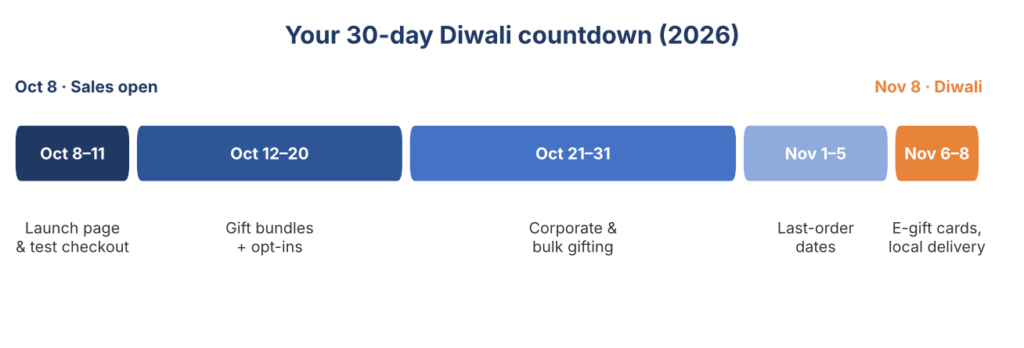
Your 30-Day Countdown to Diwali
| When | Focus |
|---|---|
| Oct 8–11 | Launch the Diwali page. Test checkout. Send early-access message to returning buyers. Keep marketplace listings stocked and priced competitively. |
| Oct 12–20 | Push gift bundles on Instagram and WhatsApp. Collect opt-ins at checkout. Add reviews from early festive orders to the page. |
| Oct 21–31 | Corporate and bulk gifting push. Re-engage people who asked about products but did not buy. |
| Nov 1–5 | Publish last-order dates by region. Highlight in-stock, ready-to-ship items only. |
| Nov 6–8 | Switch to e-gift cards and local delivery offers. Pause ads on items that cannot arrive in time. |
| After Diwali | Thank-you message, delivery feedback request, and a quiet offer for the next occasion. |
Does the October 8 GST Council Meeting Change Anything?
The 57th GST Council meeting is being held on October 8, 2026 in New Delhi, after being moved twice. Reports ahead of the meeting suggested the Council could look at measures to make compliance easier for businesses, including e-commerce suppliers.
The answer for now: until the Council announces decisions and they are formally notified, nothing changes for your filings. Run your festive season on the rules in force today, and check any update with your CA before acting on it.
How Do You Measure Diwali Ecommerce Success?
When the season ends, look beyond total revenue. Track three numbers:
- Own-store share: what percentage of festive orders came through your own store.
- New opted-in contacts: how many people agreed to hear from you on WhatsApp or email.
- 60-day repeat rate: how many festive buyers ordered again by early January.
In summary: if those three numbers grow every season, your business gets less dependent on someone else’s sale calendar.
Where Wcart Fits
Wcart provides an AI-based headless ecommerce platform that lets Indian businesses build and run their own online store without writing code. Your festive traffic from Instagram, WhatsApp, QR codes, influencers and Google can land on your own Diwali page and convert. You set the offers, design the page and keep the customer relationship. See the full list of Wcart ecommerce features, or read how brands like Printro run their store on Wcart.
Keep selling on marketplaces for reach. Use your Wcart store to make sure this Diwali leaves you with customers, not just orders.
Launch your Wcart store now and have your Diwali page live before the gifting rush, or compare Wcart pricing plans first.
Frequently Asked Questions
When do the Amazon and Flipkart festive sales start in 2026?
Amazon’s Great Indian Festival began on October 8, 2026. Flipkart’s Big Billion Days started early access on October 8 for eligible members and opened to everyone on October 9.
Is it too late to start a Diwali campaign on October 8?
No. Diwali is on November 8, so there are about four weeks of buying intent left. A focused sale page, a few gift bundles and an opted-in WhatsApp list can be set up in a few days.
Can I ask marketplace buyers to order from my own website?
Check your seller agreement first. Marketplaces generally restrict using their orders or customer details to redirect buyers. Build own-store demand through social media, brand search, QR codes and your own contacts instead.
Do I need permission to send WhatsApp offers?
Yes. Message only people who have opted in, and give them an easy way to stop. This protects your number and keeps you on the right side of data protection rules.
What should a Diwali sale page include?
A clear offer with an end date, bestsellers, gift bundles by budget, delivery and return details, customer reviews, and two actions: buy now or ask on WhatsApp.
Has GST changed for online sellers after the October 8 Council meeting?
Not until decisions are announced and formally notified. Follow the current rules and confirm any change with a tax professional.

























Leave a Reply