
Quick Answer : TikTok Marketing turns short-form video into a discovery engine that connects brands directly with shoppers. TikTok Shop merges entertainment with commerce, letting customers buy without leaving the app. Brands that blend authentic content with smart product showcases often see higher engagement and sales than on traditional storefronts alone.
Key Takeaways
- Global TikTok Shop GMV is projected to reach $112.2 billion in 2026, up from $64.3 billion in 2025, a roughly 70% year-over-year jump. (Source: eMarketer )
- 67% of TikTok users say the platform inspires them to shop even when they weren’t planning to. (Source: Dotdigital)
- TikTok users are 1.5 times more likely to buy a product they discovered on the platform compared to other social networks. (Source: Shopify)
- Live shopping events convert at 8-12%, well above the 2-4% typical of traditional ecommerce, and BFCM 2025 alone generated $500 million in TikTok Shop sales. (Source: TikTok Newsroom)
This guide covers both halves of that equation in equal depth. The marketing side (how the algorithm works, what content actually performs, how to build a strategy) and the commerce side (how to set up TikTok Shop, what it costs, how to connect it to your store, and how to measure whether any of it is working).
What Is TikTok Marketing and How Is TikTok Shop Different?
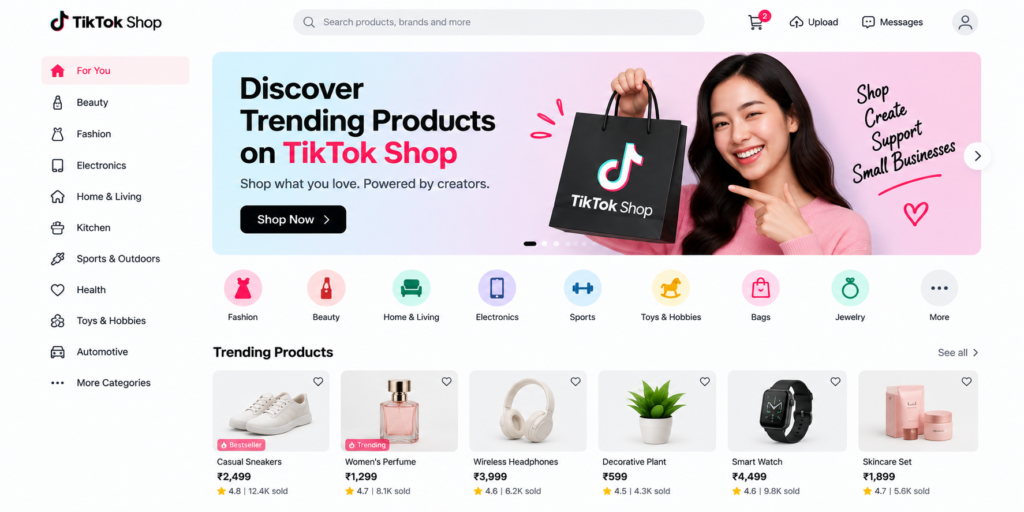
These two terms get used interchangeably, but they solve different problems and deserve separate strategies, even though they work best when run together.
TikTok marketing
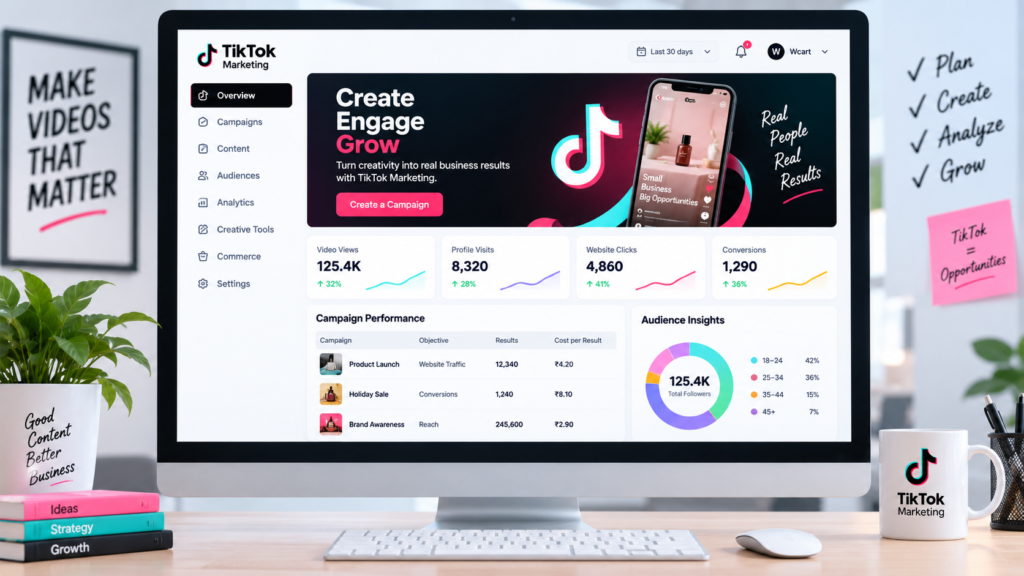
TikTok marketing is the content side. It’s how a brand builds an audience, earns attention, and gets discovered by people who weren’t looking for it.
- Organic video posting and trend participation
- Influencer partnerships
- Paid ad campaigns run through TikTok’s ad platform
None of this requires TikTok Shop to exist. A brand can run a strong TikTok marketing presence while still sending traffic to an external store.
TikTok Shop
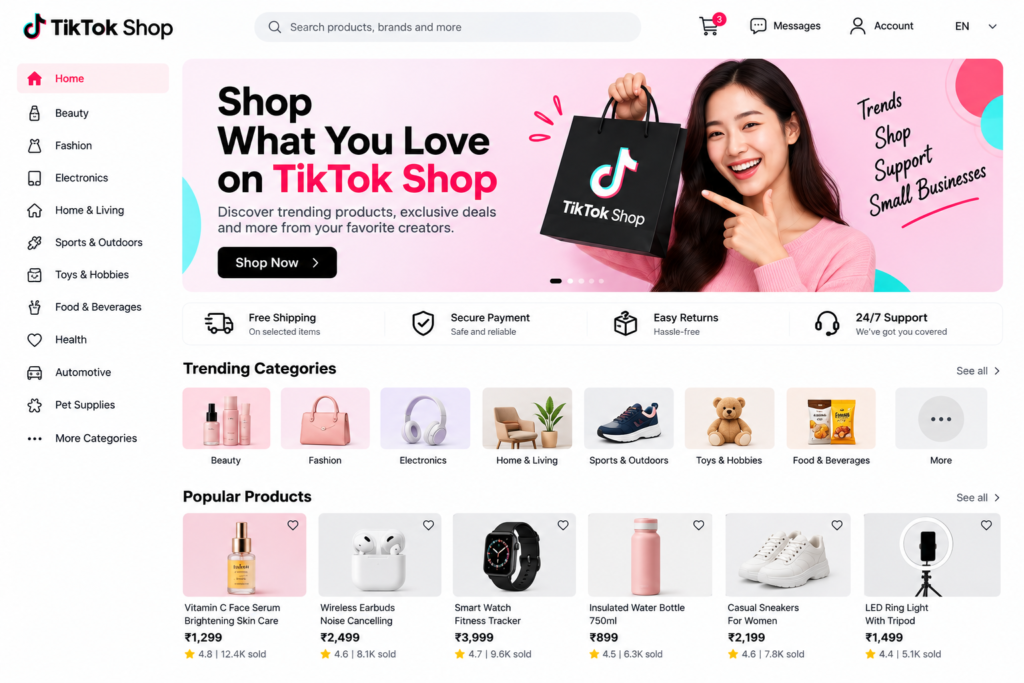
TikTok Shop is the commerce layer. It’s the actual storefront infrastructure sitting inside the app:
- Product catalogs and a shop tab on your profile
- Product tags inside videos and livestreams
- A native checkout that never sends the customer anywhere else
Nearly 60% of TikTok Shop’s GMV is now driven directly by short-form video content rather than static listings. The shop performs best when it’s fed by strong organic and creator content, not treated as a separate, disconnected sales channel.
How the two work together:
Think of TikTok marketing as the discovery engine and TikTok Shop as the checkout that catches the demand that engine creates.
- A brand with great content but no shop loses the sale to a redirect and a slower, more abandonable path
- A brand with a shop but no compelling content has a storefront nobody finds
The strongest results come from running both at once, with content built specifically to lead into a tagged product rather than as an afterthought.
How Does the TikTok Algorithm Work for Ecommerce Brands?
Unlike a platform where follower count decides your reach, TikTok’s algorithm decides distribution almost entirely on how a specific video performs in its first hour or two.
What signals the algorithm actually rewards:
- Rapid likes, shares, comments, and saves in the opening window after a post goes live
- Watch time and completion rate, meaning videos that hold attention through to the end get pushed to more viewers than videos people scroll past halfway through
- Rewatches, which signal strong enough content that someone watched it more than once
- Participation in trending sounds or hashtags, which connects your content to an audience already actively searching those tags
This means a brand with 200 followers can outperform a brand with 200,000 if the smaller account’s video earns stronger engagement signals in that critical early window. Follower count is a vanity metric here far more than it is a distribution advantage.
Why hooks matter more than production value: the first one to three seconds of a video decide whether someone keeps watching or scrolls past.
- A polished, expensive-looking ad with a slow build gets skipped
- A rougher video that opens mid-sentence with genuine tension (“nobody told me this about my skincare routine until…”) holds attention because it creates an immediate reason to keep watching
Who Can Sell on TikTok Shop and Which Countries Support It?
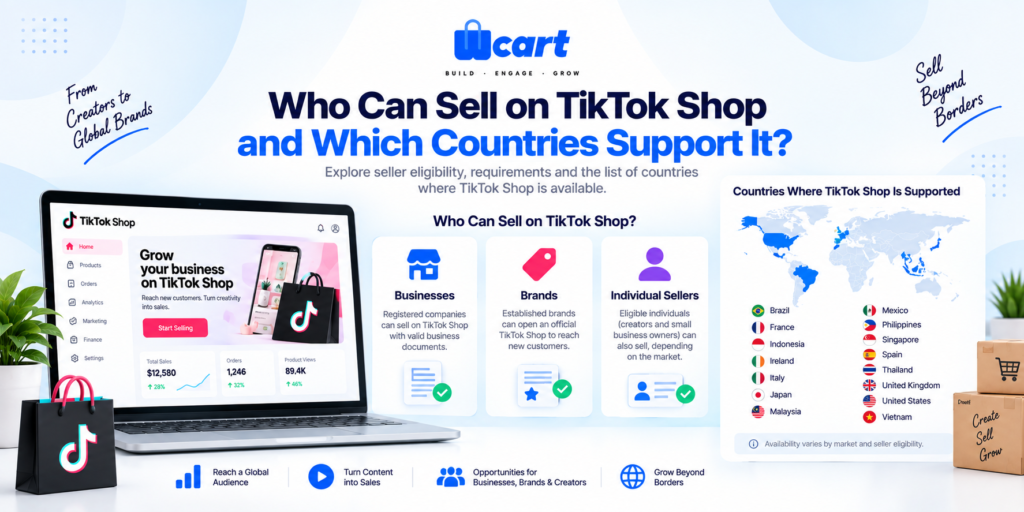
TikTok Shop isn’t available everywhere yet, and eligibility depends on both your business type and your location.
Eligibility requirements:
- Existing brands or ecommerce businesses looking to add TikTok as a new sales channel, with no minimum follower threshold required to apply as a seller
- Individual creators who want to sell their own products or earn commission promoting other brands’ products
- A registered business located in a country where TikTok Shop currently operates, along with the required tax and banking documentation for that region
Countries where TikTok Shop currently operates:
The platform now spans 16 or more countries.
- North America and Europe: the United States, the United Kingdom, and ten European markets (France, Germany, Ireland, Italy, Spain, Austria, Belgium, the Netherlands, and Poland as of mid-2026)
- Southeast Asia: Indonesia, Malaysia, Thailand, Vietnam, the Philippines, and Singapore
If your store already sells into several of these regions, it’s worth checking our guide on local payment methods for international ecommerce, since payment preferences in these markets vary just as much as they do on your own storefront.
How Do You Set Up TikTok Shop for Your Store?
Setting up TikTok Shop is a sequential process, and rushing a step usually means redoing it later.
Step 1 — Verify your business.
- Provide the tax identification and banking details TikTok requires, which vary by region. This step gates everything else, so start it before building any content strategy around the shop.
Step 2 — Connect or upload your product catalog. Once approved, TikTok can sync products directly from your store’s backend, or you can upload items manually.
- Reformat titles, descriptions, and images for TikTok’s vertical, mobile-first display
- A listing built for a desktop store page often looks cramped or unclear on a phone screen inside the app
Step 3 — Configure shipping, returns, and payouts.
- Set shipping options and return policies through TikTok’s seller dashboard.
- Clear, specific policies here reduce buyer hesitation and cut down on disputes later.
- Set up your payout schedule and tax handling at the same time so cash flow doesn’t stall once orders start coming in.
Step 4 — Claim your shop tab and go live.
- Claim your brand’s TikTok Business account, enable Shop features, and set up the shop tab on your profile.
- From here, you can start tagging products in organic posts, scheduling livestream shopping events, or launching paid campaigns that link directly to the shop.
How Do You Link TikTok Shop to Your Ecommerce Platform?
Running TikTok Shop as a disconnected, manually managed channel works for a short time, but it breaks down fast once order volume grows.
API and native integrations by platform: most major ecommerce platforms offer either a native TikTok Shop integration or API access that lets a third-party app handle the connection.
- Your existing product catalog, pricing, and inventory push into TikTok Shop automatically
- No duplicate manual listing process needed
For a headless, white-label setup like Wcart, this connection runs through the same API and webhook infrastructure that powers your other integrations, so TikTok Shop becomes one more connected channel rather than a separate system living outside your actual store data.
Keeping inventory and orders in sync: the real risk of running TikTok Shop unintegrated is overselling, since a product can sell out on your main site while TikTok Shop still shows it as available, or vice versa.
- A proper integration syncs stock levels in both directions in real time
- New orders from TikTok Shop push back into your central order management system automatically
- Fulfillment doesn’t require someone manually checking a second dashboard all day
What Does It Cost to Sell on TikTok Shop?
Commission structure has shifted since TikTok Shop’s early days, and it now varies meaningfully by category and region.
Commission structure: TikTok Shop’s base platform fee runs 1.8-5% plus a small per-transaction charge, with total seller costs (including creator commissions) commonly landing in the 8-13% range once affiliate payouts are factored in. (Source: Ringly’s TikTok Shop Statistics)
- Fashion creators often work on 8-12% commissions
- Beauty and wellness creators command 12-18%
- Consumer electronics typically sit at the lower end of the range
- EU commission fees rose from 5% to 9% for most categories in January 2026, following a pattern TikTok already ran in the UK
Tax and compliance basics:
Tax and data collection requirements vary by region, so sellers need to configure tax settings correctly within TikTok’s dashboard and disclose data practices in line with local regulations.
Sellers operating across multiple countries, especially the newer European markets, should expect this to take real setup time rather than a single toggle.
What Is the Best TikTok Marketing Strategy for Ecommerce Brands?
A strategy here means having a plan for what gets posted, how often, and why, rather than posting reactively whenever something feels trend-worthy.
Building a content calendar:
Effective calendars balance trending content with evergreen posts.
- Identify recurring themes (product demos, customer stories, behind-the-scenes, trend participation) and assign them across the week instead of repeating one content type
- Aim for at least three to five posts per week to maintain the consistency TikTok’s algorithm rewards
- Plan around seasonal events and product launches in advance rather than scrambling the week of
Balancing trend participation with brand fit:
Not every trend is worth joining. A trend only works for a brand if it can be adapted naturally to the product, not forced.
- A skincare brand joining a dance trend with no product connection reads as noise
- The same brand adapting that trend’s structure to showcase a routine reads as native content
Test performance weekly, and replace formats or themes that consistentlyunderperform rather than sticking with a calendar plan out of habit.
What Are the Best TikTok Video Formats and Content Ideas for Ecommerce?
Certain formats consistently outperform others for ecommerce brands specifically, because they match how people actually want to consume content on this platform.
1. Problem-solution demos open with a clear pain point, then introduce the product as the fix. A video about tangled earbuds leading into a wireless charging case works because it starts with something the viewer already relates to.
2. Before-and-after transformations suit beauty, fitness, home organization, and skincare especially well, since the visual payoff of the “after” state does most of the persuasive work without needing a hard sell.
3. Educational clips share a quick tip, hack, or how-to tied to the product, like “5 ways to style this scarf.” These perform well because they feel useful independent of whether the viewer buys.
4. Behind-the-scenes content shows product creation, packaging, or team stories, which humanizes the brand and builds the kind of trust that pure product content can’t.
5. Live shopping events let a brand demonstrate products, answer questions in real time, and offer exclusive deals during the stream.
- Live shopping conversion rates run at 8-12% during active events, well above the 2-4% typical of standard ecommerce
- Scarcity and a live host both push urgency in a way a static post can’t replicate
- TikTok’s own Black Friday-Cyber Monday 2025 weekend generated $500 million in Shop sales, with 760,000+ livestream sessions run by sellers over the four-day window (Source: TikTok Newsroom)
Which Products Sell Best on TikTok Shop?
Not every product category is a natural fit, and understanding why some categories dominate helps set realistic expectations before investing heavily.
Product categories that perform well:
- Beauty and Personal Care leads the platform, generating $2.49 billion in US TikTok Shop GMV in a single year
- Womenswear and underwear also rank among the top categories by store count
- Kids’ fashion, baby and maternity, and modest fashion have posted some of the fastest recent growth rates, showing the platform expanding beyond its original beauty-and-fashion base
Products that solve an everyday problem, demonstrate a clear transformation, or tap into an existing trend tend to outperform commoditized items that don’t lend themselves to a 30-second demonstration.
Where dropshipping fits, and its limits:
Dropshipping is possible on TikTok Shop, but it comes with real friction.
- TikTok Shop increasingly favors sellers who can fulfill quickly and reliably
- Dropshipping’s longer, less predictable shipping timelines can hurt both conversion and seller standing
It’s a workable entry point for testing product-market fit at low upfront cost, but brands planning to scale seriously tend to move toward owned or closer-to-source inventory once a product proves itself.
How Do Influencers and Creators Drive TikTok Shop Sales?
Creators aren’t a side channel on TikTok Shop, they’re close to the platform’s primary revenue engine, and treating them that way changes how a brand should allocate budget and attention.
Affiliate programs vs. paid partnerships:
An affiliate program lets creators earn a commission on sales they personally drive, which incentivizes genuine, ongoing promotion rather than a one-off sponsored post.
- Affiliate content alone drives 42% of all US TikTok Shop GMV, the platform’s single largest sales channel
- Paid partnerships and ambassadorships work better for brand awareness and longer-term storytelling
- Affiliate relationships tend to drive the highest volume of direct, trackable sales
Micro-influencers vs. macro-influencers:
Micro-influencers, those with smaller but highly engaged followings, often deliver stronger conversion rates than mega-influencers, since their audiences feel the recommendation is more personal.
- Only about 5.57% of the platform’s influencers actively sell products through the affiliate program
- That small group generates an affiliate link engagement rate roughly 160% higher than Instagram’s equivalent
Sellers who commit to this channel seriously see outsized returns relative to the size of the group doing it.
Disclosure and compliance requirements: any sponsored or affiliate content needs clear disclosure of the relationship between creator and brand. Use TikTok’s branded content tools to tag partnerships properly rather than relying on a verbal mention in the video, since proper tagging keeps both the brand and the creator compliant with the platform’s advertising policies.
How Do You Measure TikTok Marketing ROI and TikTok Shop Performance?
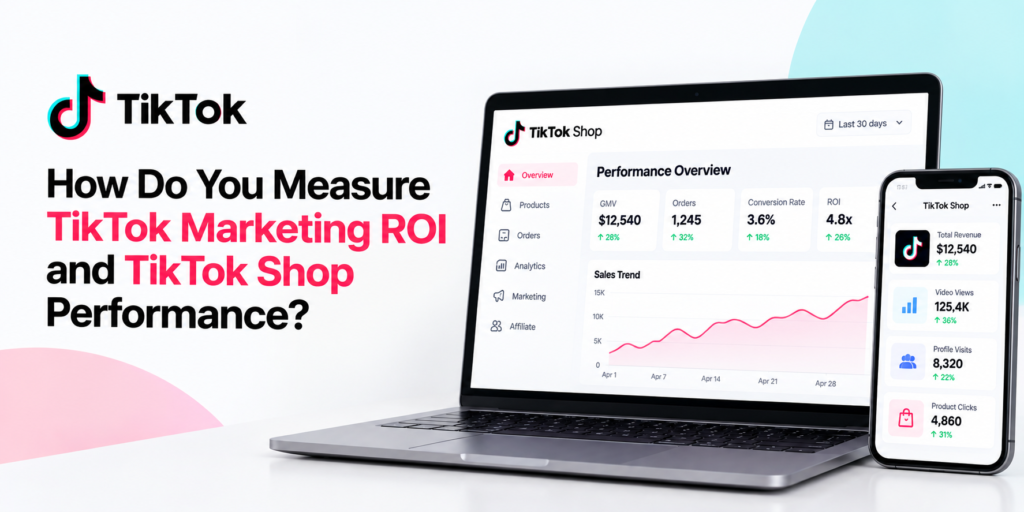
Measuring this channel well means tracking content performance and shop performance as two related but distinct sets of numbers, then combining them into a true cost picture.
Content performance metrics:
- Watch time and completion rate indicate whether the content itself is holding attention
- Click-through rate shows how effectively a video converts interest into an actual tap on a tagged product
- TikTok reports standard ad-driven benchmarks around 0.8-0.9% CTR and 0.3-0.6% conversion, though organic and creator-led content frequently outperforms these paid benchmarks
Shop performance metrics:
Track add-to-cart rate and completed purchase rate directly inside TikTok Shop’s analytics dashboard to see which specific videos and products are actually driving revenue, not just views.
- Product-level conversion rates commonly fall in the 3-8% range, meaningfully higher than most traditional social commerce channels
- This gap is part of why brands are shifting real budget toward this platform rather than treating it as experimental spend
Calculating true ROI:
A complete picture needs to include ad spend, influencer or affiliate commission payouts, and platform fees, set against total revenue generated through the shop.
- After commissions, fees, and returns, brands typically keep roughly two-thirds of their reported GMV
- Treat the headline GMV number as a starting point, not the final answer
- Cross-reference against your own store’s repeat purchase rate for TikTok-acquired customers, since a high repeat rate signals real product-market fit better than first-purchase volume alone
If you’re also running email flows to re-engage these customers after their first TikTok-driven purchase, our guide on essential email list building strategies covers how to capture and follow up with buyers acquired this way.
TikTok Shop vs. Other Sales Channels: Is It Worth It?
| Factor | TikTok Shop | Wcart | Shopify | Instagram Shopping |
| Discovery mechanism | Algorithm-driven, no follower requirement | Requires your own traffic (ads, SEO, content) | Requires external traffic (ads, SEO, social) | Follower-based, weaker discovery for new accounts |
| Checkout location | Fully native, inside the app | Fully owned, on your own domain | Native, fully owned by the brand | Often redirects out to an external store |
| Commission/fees | Roughly 8-13% in the US, varies by category and region | No per-sale platform commission on a self-hosted setup | Platform and payment processing fees only, no per-sale commission | Standard payment processing fees, no platform commission |
| Data ownership | Limited, TikTok controls most customer data | Full ownership, including every TikTok-acquired customer once they convert on-site | Full ownership | Partial, depends on checkout flow |
| Channel connections | Native inside TikTok only | Connects to TikTok Shop, Instagram, and other channels through open APIs | Connects via apps and integrations | Native inside Instagram only |
| Best for | Visual, demonstrable products with creator-fit content | Long-term brand ownership plus multi-channel selling from one backend | Long-term brand ownership and full customer data control | Brands with an already-engaged Instagram following |
Is it worth it? For a brand selling a visual, easily demonstrated product, yes, given the growth rate and the sheer size of GMV moving through the platform.
- The trade-off is data ownership and commission cost versus a standalone store
- Most brands running TikTok Shop successfully treat it as one channel in a broader strategy, not a replacement for their own store
- The customer relationship and repeat-purchase data are harder to fully own inside TikTok’s own platform
If you’re weighing this alongside broader checkout strategy, our guide on increasing ecommerce conversion rates covers how to strengthen the owned-store side of that equation.
What Are Common Mistakes Brands Make With TikTok Shop?
A handful of mistakes show up repeatedly across brands new to the platform, and most are avoidable with a small mindset shift before launch.
- Over-promotional content – feels like a traditional ad, gets scrolled past. Lead with storytelling, not a sales pitch.
- Ignoring trends entirely – misses real organic reach. Adapt trends to the brand’s niche, don’t join for the sake of joining.
- Inconsistent posting – TikTok rewards consistency; sporadic posting struggles to build algorithm momentum.
- Poor product-market fit – not every product works here. Test with a small audience before committing real spend.
- Neglecting customer service – buyers expect fast responses. Slow replies damage sales and seller reputation.
- Skipping user-generated content – misses some of the most authentic, high-converting social proof available on the platform.
Boost Your Ecommerce Sales with TikTok Marketing and Wcart’s Headless Commerce Platform
Ready to supercharge your TikTok Shop and online store? Seamlessly integrate TikTok marketing with Wcart’s headless commerce platform for a faster, more flexible shopping experience. Elevate your ecommerce strategy with Wcart today!
Frequently Asked Questions
For deeper strategies on expanding beyond TikTok,
- Explore Social Commerce: How to Sell Products Across Social Media Channels.
- To learn how to adapt your Instagram presence into a storefront, read Instagram Shopping Setup: Turning Your Profile Into a Storefront.
- If you’re evaluating other platforms, consider Which Social Media Platforms Are Best for Your Online Store.
























Leave a Reply