
Quick Answer
Ecommerce email marketing works by combining a growing subscriber list with automated drip campaigns that react to real customer behavior, like an abandoned cart or a browsed product. Email marketing returns $36 to $45 for every $1 spent in the ecommerce category specifically, and automated flows generate up to 30 times more revenue per email than one-off campaigns. A solid ecommerce email marketing strategy rests on four things: list building, segmentation, automation, and consistent measurement.
Key Takeaways
- Email marketing earns $36 for every $1 spent on average, and $45 for the ecommerce category specifically. (Source: Litmus via Klaviyo)
- Automated flows like abandoned cart and post-purchase emails generate up to 30 times more revenue per recipient than standard one-off campaigns. (Source: Klaviyo)
- Abandoned cart emails are the single highest-performing automated flow, driving a 2.68% placed-order rate and $3.07 in revenue per recipient. (Source: Klaviyo Email Marketing Benchmarks)
- Automated emails generated 30% of total email revenue from just 2% of total sends in one large 2026 merchant analysis. (Source: Omnisend 2026 Ecommerce Marketing Report)
- Global email marketing revenue is projected to reach $16.9 billion by 2027, and email marketing remains connected to over 4.5 billion email users worldwide. (Source: Statista via BigCommerce)
Ad costs keep climbing and social algorithms keep changing what gets seen. Your email list doesn’t have either problem. It’s the one channel where you decide who hears from you and when, which is exactly why email marketing for ecommerce keeps outperforming nearly every other channel on return for the dollar spent.
This guide covers the full ecommerce email marketing strategy: building the list, automating the right drip campaigns, segmenting for relevance, and measuring what actually matters.
What Is Ecommerce Email Marketing?
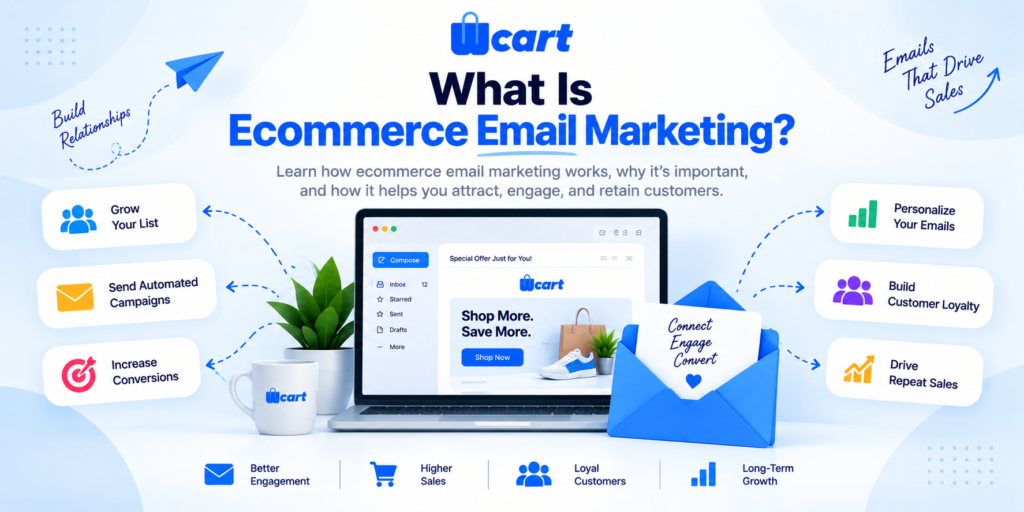
Ecommerce email marketing is the practice of using email to turn site visitors into subscribers, subscribers into buyers, and buyers into repeat customers. It runs on customer data and behavior instead of a one-size-fits-all newsletter blast.
- It starts the moment someone subscribes and continues through the entire customer relationship
- It reacts to real actions: a product view, an abandoned cart, a completed purchase, a period of inactivity
- Unlike a rented social audience, your list is an asset you fully own and control.
Types of Ecommerce Email Marketing
| Category | What It Includes | Purpose | Example |
| Automated flows | Welcome, abandoned cart, post-purchase, win-back | Triggered by shopper behavior, runs continuously with no manual send | “You left something behind” |
| Scheduled campaigns | Flash sales, launches, seasonal sends | Sent to a chosen segment at a time you control | “48 hours only: 20% off sitewide” |
| Transactional emails | Order confirmations, shipping updates, password resets | Functional communication that also carries marketing value | “Your order is confirmed” |
| Promotional emails | Discounts, limited-time offers | Creates urgency around a specific action | “Flash Sale: 60% off ends tonight” |
| Lifecycle emails | Welcome series, post-purchase, win-back | Matched to where the customer sits in the relationship | “Welcome! Here’s 15% off” |
| Educational/content emails | How-to guides, styling tips, brand stories | Builds trust between purchases without asking for a sale | “3 ways to style your new jacket” |
Why Your Ecommerce Email Marketing Strategy Should Start With List Ownership
A social platform can restrict your account or change its algorithm overnight. Your email list can’t be taken from you, since every contact on it opted in directly to hear from your brand.
- Over half of marketers report at least a 100% improvement in results once they invest properly in email campaigns. (Source: BigCommerce )
- Email delivers direct, unfiltered access to people who’ve already shown real interest in your brand, unlike a passive social scroll
- Building this asset early means every dollar spent on ads or content also feeds a channel you’ll own forever
How Do You Build an Ecommerce Email List?
List building for ecommerce comes down to placing the right offer in front of the right visitor at the right moment. We cover this in full depth, including 11 specific email types and real conversion benchmarks, in our dedicated guide to ecommerce email list building.
The short version:
- Use pop-ups triggered by scroll depth or exit intent, not immediate page load
- Offer a specific, real incentive (a discount, early access, exclusive content), not a vague “join our newsletter” ask
- Add checkout opt-in, since a buyer is your warmest possible lead
Beyond the core automation flows above, a mature ecommerce email program layers in specific email types for confirmation, shipping, reviews, replenishment, and loyalty. We break down all 11 email types in detail, with example subject lines, timing, and per-type performance stats, in our guide on emails every ecommerce list should have.
How Do You Automate Ecommerce Email Campaigns With Drip Sequences?
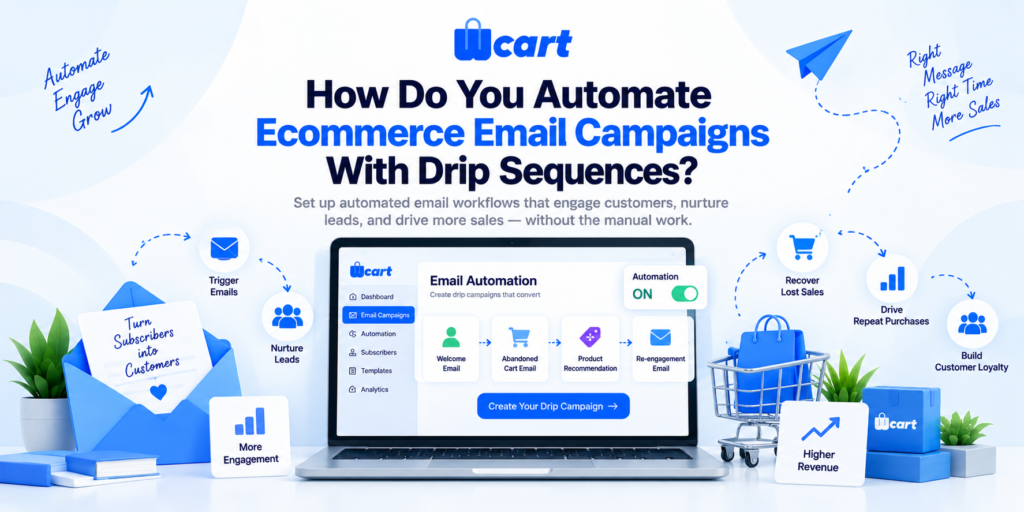
Ecommerce email automation is what separates a store that grows from one that plateaus. A drip campaign reacts to what a specific shopper does, rather than sending the same message to everyone on the same day.
| Automation | Trigger | Typical Timing | Why It Works |
| Welcome series | New signup | Immediately, then over 1-2 weeks | Subscribers are most receptive in the first 48 hours after opting in |
| Abandoned cart | Cart left without checkout | 1-3 hours, then 24 and 72 hours | Highest revenue per recipient of any automated flow |
| Browse abandonment | Product viewed, no cart add | A few hours after the view | Converts at roughly 10 times the rate of a standard campaign |
| Post-purchase | Order placed or delivered | Immediately, then 3-14 days later | Open rates run as high as 59.77% in some benchmark sets |
| Win-back | No purchase in 60-90 days | Day 60, then day 90 | Reactivates a meaningful share of lapsed buyers at low cost |
How Do You Segment Your Ecommerce Email List for Better Results?
Ecommerce email segmentation means grouping subscribers by shared traits or behavior so each group gets a message that’s actually relevant to them, instead of one message going to everyone.
- Behavioral segmentation – grouped by purchase history, browsing activity, or engagement level
- Demographic segmentation – age, gender, or location, useful but weaker alone than behavior-based groups
- Lifecycle stage – new subscriber, first-time buyer, or loyal repeat customer, each needing a different message
- Geographic segmentation – respects local holidays, shipping realities, and seasonal timing
A travel brand that sent location-targeted emails to customers near a new retail location saw 52% year-over-year growth in attributed revenue, a result driven entirely by matching the message to the right audience. (Source: Klaviyo customer case study)
Which Metrics Actually Matter for Ecommerce Email Marketing
| Metric | What It Tells You | Trust Level | Notes |
| Revenue per recipient (RPR) | Total revenue ÷ emails delivered | High optimize this first | The clearest single measure of whether an email made money |
| Placed order / conversion rate | % of recipients who purchase | High | Ties engagement directly to a sale |
| Average order value from email | Whether email-driven orders run higher or lower than site average | High | Reveals if recommendations and upsells are working |
| Open rate | Subject line effectiveness | Diagnostic only | Privacy features can register an “open” with no human involved |
| Click-through rate (CTR) | Content relevance | Diagnostic only | Automated security scanners can inflate this number |
| Bounce rate | List health | Protective | Rising bounces signal a list that needs cleaning |
| Unsubscribe rate | Frequency or relevance mismatch | Protective | A spike usually means too many sends or a broken promise from signup |
| List growth rate | Whether signups outpace natural decay | Protective | A shrinking list needs new capture, not just better sends |
How Do You Integrate Email With Social Commerce?
Social media and email aren’t competing channels, they’re complementary. Social is built for discovery, email is built for retention and conversion.
- Drive signups from social – run ads or posts leading to a landing page with a real lead magnet, since 29% of consumers discover new ecommerce brands through organic social and another 10% through influencer content. (Source: Klaviyo)
- Retarget engaged social users through email – if someone watches a product video but doesn’t buy, an email can bring them back with the exact product they viewed
- Feature user-generated content – customer photos shared on social make strong, authentic content inside a review-request or post-purchase email
Which Email Service Provider Should You Use for Ecommerce?
The right ESP depends on your store’s size, technical resources, and how deep you need your ecommerce data integration to go.
| ESP | Best For | Standout Feature |
| Klaviyo | Data-heavy brands wanting deep segmentation | Predictive analytics and granular ecommerce data sync |
| Omnisend | Stores wanting email, SMS, and push in one tool | Native store integrations across 280+ platforms |
| Mailchimp | Smaller stores wanting a simple starting point | Familiar interface, wide template library |
| ActiveCampaign | Teams that also want CRM functionality | Purchase-triggered automations with built-in CRM |
Because a headless, white-label platform like Wcart separates the storefront from backend logic, you’re free to connect any of these ESPs through API access rather than being locked into whatever your platform bundles by default.

























Leave a Reply