
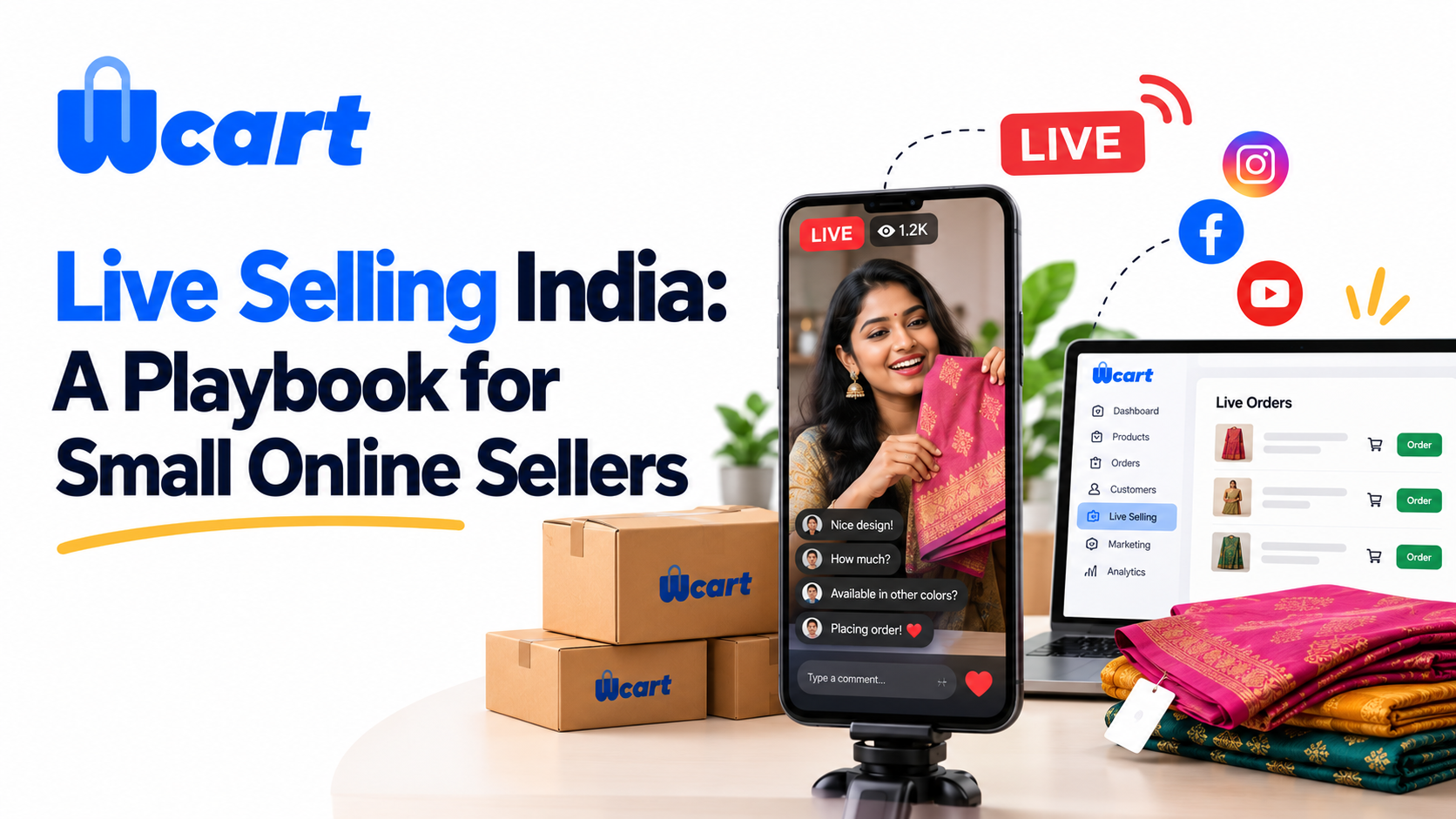
Quick answer: Live selling in India works when you demo a product on Instagram Live or YouTube Live, answer the doubts that stop people buying, and send viewers to one product page on a store you own. TikTok Shop is not available in India, so checkout has to happen on your own ecommerce store. The sellers who win treat live selling as a weekly system, not a one-off event.
Most live-shopping success stories come from markets with TikTok Shop. India doesn’t have it. That doesn’t make the lessons useless. It means Indian sellers rebuild the same engine with different parts: Instagram Live, YouTube Live, WhatsApp, and their own store.
Wcart provides an AI-powered headless ecommerce platform that lets businesses build, run, and scale an online store without coding. In this playbook, Wcart is the store where live viewers land and check out. You can see how it works on the Wcart online store builder page.
This guide takes four documented brand stories, strips out what only works on TikTok, and turns what’s left into a system a small Indian seller can run with a phone, a ring light, and a store link.
The short version
Live selling works when four things happen in sequence:
- Show the product doing its job, not just sitting in a frame.
- Solve the doubt that’s stopping the purchase: size, shade, delivery date, COD, returns.
- Send the buyer to one specific product page, not a homepage.
- Study what sold, what didn’t, and what each order actually earned.
Bottom line: show, solve, send, and study, then repeat every week. None of the brands below got there with one viral stream.
How is live selling in India different from TikTok Shop?
On TikTok Shop, discovery, product listing, and checkout happen inside one app. A viewer taps and buys without leaving the stream. Indian sellers don’t get that loop by default, so every extra step between “I want this” and “order placed” leaks buyers.
| What TikTok Shop gives UK sellers | What an Indian seller has to build |
| In-app checkout during the stream | A product link on a store you control, pinned in comments and bio |
| Platform-run payments | UPI, cards, and a decision on cash on delivery |
| Built-in buyer trust from the marketplace | Your own trust signals: reviews, return policy, delivery dates, GST invoice |
| Algorithmic push to shoppers | Your own audience: followers, WhatsApp opt-ins, repeat buyers |
| Order tracking inside the app | Order updates you send yourself |
The upside: when the buyer checks out on your store, you keep the customer’s details, the order history, and the right to market to them again with consent. On a marketplace, that relationship belongs to the platform.
Four brands, four lessons, translated for India
1. Glow For It: the demo is the sales pitch
Daisy Kelly started Glow For It in 2020 from her mother’s kitchen table, while still at university, selling a lash serum she developed after her own experience with eyelash pulling. According to the BBC, she said one 12-hour TikTok livestream brought in more than £100,000. IBTimes UK reports that over 40% of the brand’s sales now come through TikTok Shop UK.
The real lesson: a serum’s photo can’t answer “will this work on me?” A live demo, a founder’s own story, and answers to real questions can.
For the Coimbatore market: A Coimbatore hair-oil brand doesn’t need 12 hours. It needs 30 minutes on Instagram Live doing a scalp-massage routine, answering “is it safe for color-treated hair?” in Tamil and English, and pinning one Wcart product link in the comments.
2. Ridiculously Rich by Alana: local product, national shelf
Welsh baker Alana Spencer used TikTok Shop to sell beyond her local area. According to TikTok for Business’s published case study, the brand recorded 60,000+ orders, a 45% rise in GMV over the comparison period, and a 47.25% lift in livestream GMV after campaign optimization. These are platform-reported campaign results, not a forecast.
The real lesson: demand for a local product often exists far outside the neighborhood. The ceiling is fulfillment, not interest.
For Tamil Nadu and Maharashtra sellers: A Tirunelveli halwa maker or a Kolhapur chappal workshop can sell to Bengaluru and Pune buyers — but only after deciding shelf life, packaging, and serviceable pin codes. Set delivery zones on your store before you go live, not after the orders arrive.
3. L’ERA: show up on schedule
Mother-and-daughter founders Lara Sofia-Mar and Angèle Sofia launched L’ERA in London in 2023. According to InternetRetailing, the brand made more than £140,000 in TikTok Live revenue in 2025 from roughly four streams a week, with more streams during peak retail periods.
The real lesson: a fixed schedule turns viewers into a returning audience, and gives you enough sessions to learn what sells.
For the Indian market: Anchor the calendar to Indian buying moments — salary week, Dhanteras, wedding season, Akshaya Tritiya for jewelry. “Every Thursday at 8 PM” plus special festive streams beats random bursts
4. Ceuticoz: earn the right to expand
Ceuticoz is a bootstrapped Indian skincare brand founded by Sukhbir Singh Chimni. According to ETRetail, it reported about ₹26–27 crore in revenue for the previous fiscal year and is targeting ₹40 crore this year, alongside expansion across India and into the Gulf. The ₹40 crore figure is a target, not a result.
The real lesson: expansion is a reward for a profitable core, not a growth strategy on its own.
For Indian D2C brands: Don’t take 40 SKUs live. Take the three that get reordered, prove the margin per order, then add the next category or city.
Bottom line: demo the product, sell where you can fulfill, show up on a fixed schedule, and grow only from a profitable core.
The Show → Solve → Send → Study loop
Every session runs the same four stages. The last stage feeds the next session’s first, so each stream should sell a little better than the one before.
| Stage | What you do live | What your Wcart store must have ready | What to measure |
| Show | Use the product on camera: apply it, wear it, cook with it, unbox it | Real product photos and a short video on the product page | Peak viewers, average watch time |
| Solve | Answer the doubts that block purchase: size, shade, ingredients, delivery date, COD, returns | A clear return policy, delivery timelines, and FAQ on each product page | Questions asked, repeated objections |
| Send | Pin one product link per item; say the product name and price out loud | One focused product page or collection per stream, mobile checkout that works | Link clicks, add-to-carts |
| Study | Review within 24 hours: which product, which minute, which offer | Order and traffic reports from the store | Orders, AOV, margin per order, repeat rate |
The rule that matters most: one link per product, never your homepage. Every extra tap after the stream loses buyers who were ready a minute ago.
Bottom line: every live session should end with a buyer on one product page and a number you can learn from.
Instagram Live, YouTube Live, or Facebook Live: where should you sell?
The right platform is the one where your buyers already watch you. Each platform suits a different kind of product and a different length of demo.
| Platform | Best for | Strength for sellers | Watch out for |
| Instagram Live | Beauty, fashion, jewelry, gifting, home decor | Followers get notified; Stories and Reels can promote the stream ahead of time | Links are harder to click mid-stream, so pin the product link in comments and keep it in your bio |
| YouTube Live | Appliances, gadgets, kitchen tools, explainer-heavy products | Streams stay searchable afterward and keep collecting views | Building a subscriber base takes longer than on Instagram |
| Facebook Live | Older buyers, local communities, regional products | Group sharing helps you reach community audiences | Organic reach for business pages is often limited |
You don’t have to pick only one. Many sellers go live on Instagram for reach and then upload the recording to YouTube so it keeps working for months.
Bottom line: start on the platform where your current buyers already follow you, then repurpose the recording to a second platform.
What you need to go live: a starter kit
You can run a good first live session for well under ₹10,000 in equipment. Viewers forgive a simple setup. They don’t forgive bad audio or a product they can’t see clearly.
- Phone: any recent smartphone with a clean rear camera. Use the rear camera for product close-ups.
- Tripod or phone stand: a shaky frame makes demos hard to watch.
- Ring light or softbox: true-to-life color matters for beauty, fashion, and jewelry.
- Clip-on microphone: clear audio does more for watch time than a better camera.
- Stable internet: test upload speed before you start, and keep mobile data ready as a backup.
- A second device: use it to read comments and check that product links work while you present.
- A product tray: keep every item, price card, and variant within arm’s reach.
Bottom line: spend on light and sound first, because those decide whether viewers stay long enough to buy.
A 30-minute live session, minute by minute
This run sheet works for three products on Instagram Live or YouTube Live. Late joiners are normal, so each product block repeats the price and link.
| Time | Segment | What to say or do |
| 0:00–3:00 | Warm-up | Greet people by name, say what’s coming and that there’s a live-only offer at the end |
| 3:00–10:00 | Product 1 (hero) | Demo it, share one customer result, answer the top two questions, pin the link |
| 10:00–16:00 | Product 2 | Demo, compare with Product 1 (“pick this one if…”), pin the link |
| 16:00–22:00 | Product 3 or bundle | Show how products work together, state the bundle price, pin the link |
| 22:00–27:00 | Open Q&A | Answer delivery, COD, returns, and sizing questions on camera |
| 27:00–30:00 | Close | Recap all three prices, state when the live offer ends, tell people to message on WhatsApp for help |
Before you go live: check every link on a phone, confirm stock counts, and test that the offer code works. A broken link mid-stream costs more than a weak demo.
Within 24 hours after: reply to every DM and comment question, send the replay link to people who opted in on WhatsApp, and log the numbers.
Does the live order actually make money? A rupee check
A stream that sells 15 units can still lose money once discounts, shipping, and promotion are counted. Here is an illustrative example for a ₹899 skincare product sold with a 10% live-only discount. Replace every figure with your own.
| Line item | Amount per order |
| Selling price after 10% live discount | ₹809 |
| Product cost | −₹300 |
| Packaging | −₹40 |
| Shipping | −₹60 |
| Payment gateway (about 2%) | −₹16 |
| Contribution before promotion | ₹393 |
| Promotion cost (₹3,000 boost ÷ 15 orders) | −₹200 |
| Margin per order | ₹193 |
Two things quietly erase this margin in India:
- COD returns (RTO). Every refused COD parcel costs shipping both ways and earns nothing. If RTO is high, try a small COD fee or a prepaid-only live offer.
- Stacked discounts. A live discount plus a coupon plus free shipping can push margin below zero. Decide the maximum discount before the stream, not during it.
If the margin per order is positive and buyers come back, repeat the stream. If it’s negative, fix price, bundle, or promotion before going live again.
Bottom line: a live session is only a success if the margin per order is positive after discounts, shipping, promotion, and returns.
An Indian live-selling calendar
Indian demand peaks around festivals, weddings, and payday, so your live schedule should follow them. Plan special streams around these moments and keep a steady weekly slot the rest of the year.
| Buying moment | Typical timing | Categories that fit | Live-session idea |
| Salary week | First week of every month | Most categories | “Payday picks” with a small bundle offer |
| Raksha Bandhan | August | Gifts, sweets, accessories | Gift hampers with delivery cut-off dates stated clearly |
| Onam, Ganesh Chaturthi, Navratri | August to October, varies by region | Ethnic wear, decor, food | Regional streams in the local language |
| Dhanteras and Diwali | October or November | Jewelry, decor, sweets, gifting | Gift guides by budget, corporate gifting bundles |
| Wedding season | Roughly November to February | Jewelry, ethnic wear, beauty | Bridal and guest looks, try-on demos |
| Pongal, Makar Sankranti | January | Food, traditional wear, home goods | Festive bundles for regional audiences |
| Akshaya Tritiya | April or May | Jewelry, gold-tone accessories | Collection launches timed to the day |
Festival dates move each year, so confirm them before you plan. Announce festive streams at least a week early, and close orders early enough to deliver on time.
Bottom line: keep one weekly slot all year and add festival streams on top, with delivery cut-offs stated on camera.
The WhatsApp follow-up that turns viewers into buyers
Most live buyers don’t order during the stream. They ask a question, think about it, and order later. A fast, consent-based WhatsApp follow-up recovers many of those sales.
- Collect opt-ins on purpose. Invite viewers to message you on WhatsApp for help or the replay. Only message people who have chosen to hear from you, and follow WhatsApp’s business messaging rules.
- Reply within an hour. Answer the exact question asked, then share the one product link that fits.
- Send the replay with links. Share the recording plus a short list of featured products and their links.
- Remind once, not repeatedly. A single reminder before the live offer ends is useful. Repeated messages lose trust.
- Thank buyers after delivery. Ask for a review and invite them to the next session.
Bottom line: WhatsApp should answer questions and share one relevant link, not broadcast spam.
Category playbooks: what to show for each product type
What makes a demo persuasive changes by category. Use this table to plan what to show and which question to answer before anyone asks.
| Category | Show on camera | Answer before they ask | Bundle idea |
| Skincare and beauty | Application on real skin, texture close-ups, before-and-after routine | Skin type, ingredients, shelf life | Morning and night routine kit |
| Fashion | Fit on two body types, fabric close-up, styling three ways | Size chart, fabric care, exchange policy | Outfit with matching accessory |
| Jewelry | Light reflection, clasp and finish close-up, worn with outfits | Material, plating, allergy concerns, gift packaging | Earrings and necklace set |
| Packaged food | Opening the pack, texture, serving suggestion | Shelf life, ingredients, delivery zones | Festive sampler box |
| Home decor | The item styled in a real room, scale against common objects | Dimensions, material, breakage protection in shipping | Room set for a corner or shelf |
| Handicrafts | The making process, the artisan, small details | Handmade variations, care, delivery time | Gift set with story card |
Bottom line: show what a photo can’t, and answer the one question that most often stops a purchase in your category.
Trust signals your store needs before you go live
Live viewers check your store before they pay. If the product page looks thin or vague, the stream’s energy is lost at checkout. Check these before every session:
- Clear product photos from several angles, plus a short video
- Price, variants, and stock shown accurately
- Delivery timelines and serviceable areas stated
- Return, exchange, and refund policy linked from the product page
- Payment options listed: UPI, cards, and COD if you offer it
- Genuine customer reviews, never invented ones
- Business contact details and a WhatsApp help number
- GST invoice information where applicable
- Mobile checkout tested end to end
Wcart’s ecommerce features cover product pages, payments, and order management, so most of this list can be set up on one platform.
Bottom line: the stream builds interest, but the product page closes the sale.
How to measure a live session
Views tell you who showed up. Orders and margin tell you whether the session worked. Log these numbers after every stream in a simple sheet so you can compare sessions week to week.
| Metric | How to calculate it | What it tells you |
| Peak live viewers | From the platform’s live insights | Whether your promotion before the stream worked |
| Click-through rate | Product-link clicks ÷ peak viewers | Whether the demo created buying interest |
| Add-to-cart rate | Add-to-carts ÷ product-page visits | Whether the product page matched what viewers saw |
| Conversion rate | Orders ÷ product-page visits | Whether checkout, price, and trust signals hold up |
| Average order value (AOV) | Revenue ÷ orders | Whether bundles and upsells are working |
| Margin per order | Contribution after promotion ÷ orders | Whether the session made money |
| RTO rate | Refused or returned COD orders ÷ COD orders | Whether COD is costing you more than it earns |
| 30-day repeat rate | Repeat buyers ÷ first-time buyers from the session | Whether live selling builds a customer base |
Use a separate tracked link or offer code for each session so store orders can be traced back to the stream that drove them.
Bottom line: judge every session on clicks, orders, and margin per order, not on viewer count.
A 30-day plan for your first month of live selling
One month is enough to run four sessions and learn what works for your audience. Treat the first month as a test, not a launch.
| Week | Focus | What to do |
| Week 1 | Prepare | Pick three products, update their product pages, set delivery zones, buy basic light and audio, and announce your first stream |
| Week 2 | First stream | Run the 30-minute format, follow up on WhatsApp within 24 hours, and log every metric |
| Week 3 | Adjust | Fix the biggest drop-off you found: weak demo, low clicks, or abandoned checkouts. Go live again at the same time |
| Week 4 | Repeat and compare | Run a third and fourth session, test one change at a time, and calculate margin per order for the month |
At the end of the month, keep the product, time slot, and offer that produced the best margin per order. Drop what didn’t sell, even if it got the most comments.
Bottom line: four sessions in four weeks, one change at a time, judged on margin per order.
Five mistakes that kill first live sessions
- Selling too many products. Ten items in 30 minutes means none get a proper demo. Three is enough.
- Linking to the homepage. Buyers came for one product. Send them straight to it.
- Going live with no audience plan. Announce the stream 48 hours ahead on Stories, WhatsApp Status, and to opted-in customers.
- Judging by views alone. 500 viewers and 2 orders is a weaker session than 60 viewers and 9 orders.
- Quitting after one stream. The brands above built results over many sessions. Commit to at least six before deciding.
Bottom line: fewer products, direct links, advance promotion, order-based metrics, and patience fix most failed first sessions.
Start with one stream, not a strategy deck
Pick three products. Build their pages. Announce a 30-minute live for this week. Run the Show → Solve → Send → Study loop, check the rupee math, and do it again next week a little better.
Launch your Wcart store and give your next live session somewhere to send buyers. Running a larger catalog or need custom workflows? Explore Wcart’s custom ecommerce solution.
Frequently asked questions
Is live selling possible in India without TikTok Shop?
Yes. Indian sellers commonly go live on Instagram, YouTube, and Facebook, then send buyers to their own online store to order. The difference is that checkout happens on your store, so the product link must be ready and easy to tap.
Which platform should I go live on first?
Start where your existing followers and buyers already are. For most small fashion, beauty, and jewelry sellers, that’s Instagram. For explainer-heavy products such as kitchen appliances or electronics, YouTube can suit longer demos.
Should I offer cash on delivery during live sales?
COD can increase orders from first-time buyers but raises return-to-origin risk. Many sellers test a prepaid-only live offer or a small COD fee and compare the results.
How many people do I need watching to make sales?
There’s no fixed number. A small audience that already trusts you can outsell a large, cold one. Track orders per viewer, not just viewer count.
What does Wcart do in this setup?
Wcart is the store where the buyer lands and checks out. You build product pages and collections there, share their links in streams and chats, and use the order data to plan the next session.
How long should a live selling session be?
For most small sellers, 30 to 45 minutes is enough to demo three products and answer questions. Longer streams can work for large catalogs or sale events, but only once you have a regular audience.
How often should I go live?
Start with one session a week at a fixed day and time. Add more sessions when your weekly stream consistently produces orders, and add special streams around festivals.
Can I sell food products through live selling?
Yes, if you can deliver safely. Confirm shelf life, packaging, food-safety requirements, and the pin codes you can serve before you go live, and state delivery limits clearly during the session.

























Leave a Reply